
August is here, already??
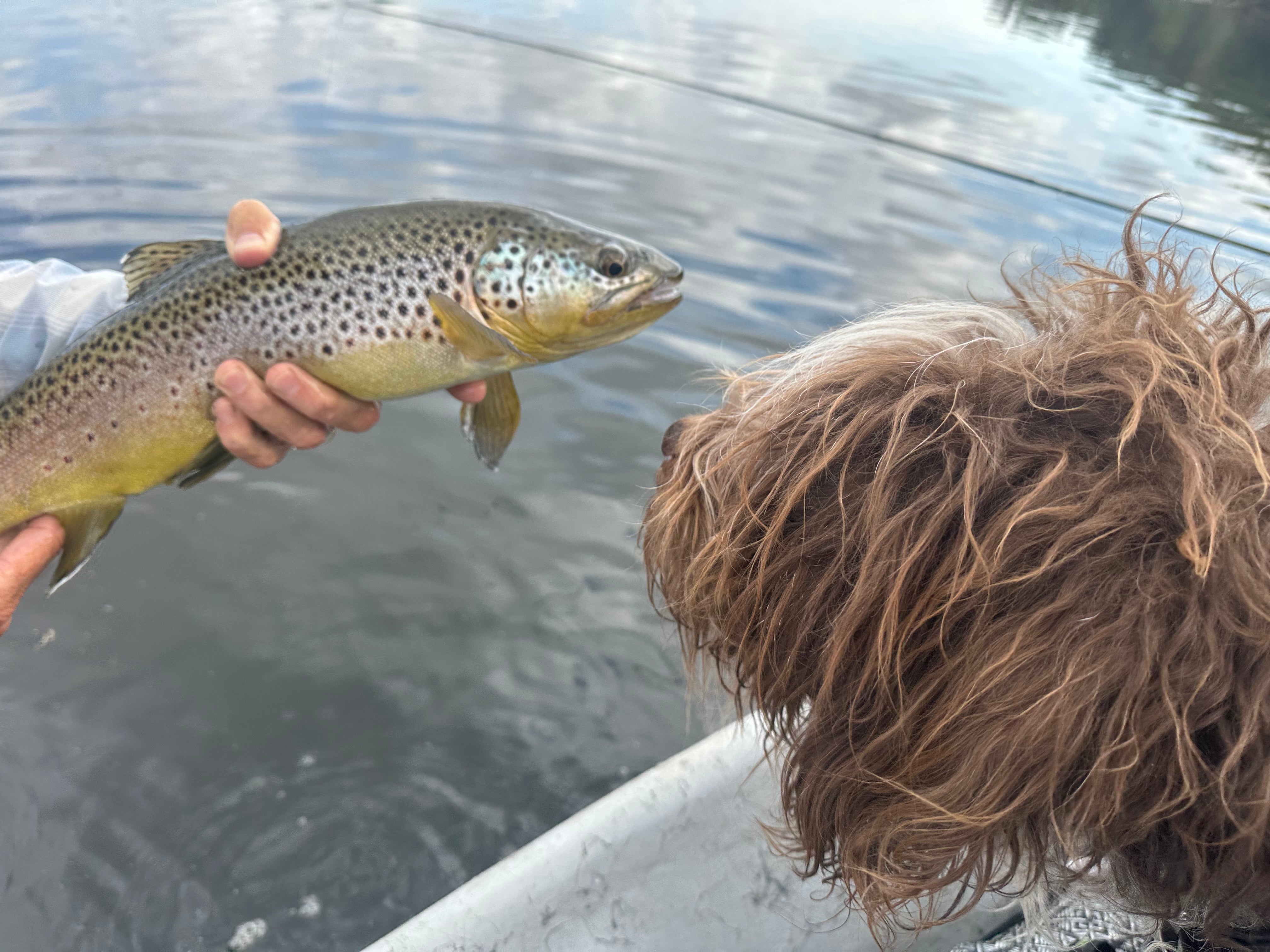
John and I returned from our epic road trip a week ago and have been getting caught up on things since. On our way back to Oregon from Minnesota, we stopped in Fort Smith, Montana on the Bighorn River and fished for three dayswith our good buddy, Hale Harris. He owns the Bighorn Trout Shop/Lodge/Guide Service and has done for longer than we have owned Deschutes Angler. We were lucky to have Hale guide us for three days - it was tons of fun catching those big rainbows and browns on the Bighorn. Most of the rivers in Montana are under hoot owl restrictions right now - due to drought conditions and hot weather, but the Bighorn is a tailwater with icy cold water coming out from the bottom of the dam (just as it once did on the Deschutes). We did well on streamers, dry flies (PMDs and Caddis), and once in a while we went to the nymphing rig just to take inventory in a riffle or two. We left at around 7:00 AM on Thursday and drove 16 hours all the way across Montana, through the pan handle of Idaho, and from Spokane down to Maupin. It was a great family adventure for me, John, and Lupine (our 15 your old Griffon). The above picture is of Lupine meeting her first brown trout - she was a champ in the drift boat - we never take her on the Deschutes because of all the snakes/ticks/dead salmon/ poison oak. Here are a few more pics from the Bighorn…


 As I announced in the last report, the steelhead season will remain open for the rest of the year - thanks to the fact that we hit our goal steelhead numbers on the 24th of July. A few folks have started to poke around looking for the early steelhead, but the town is currently dominated by the heat-of-the-summer rafting crowd. Most steelhead anglers will wait until the numbers build a bit more and come out during the prime time months of September and October. There are a few fish in the river in August, but not like what we used to see when the Deschutes was actually a cold water sanctuary for steelhead. Now that PGE is pouring the water off the top of the reservoir, the water we get is far warmer, far murkier, and far more algae-laden than it used to be.
Deschutes River Alliance has a great website where you can read all of the information about the changes in the river and how we are fighting to get our cold clean water back again. Click below to read all about the work we are doing to protect the Deschutes:
https://www.deschutesriveralliance.org
Reports are trickling in of anglers hooking steelhead down near the mouth of the Deschutes, so there are fish turning out of the Columbia and heading up the Deschutes. The numbers are exciting when we compare them to what we were dealt in the last 10 years. I did a comparison to the banner year of 2009 and what I found is that the number of wild fish that crossed Bonneville dam in July 2009 was 52,524 and this year, during the same time period, the number of wild steelhead over the Bonneville dam in July was 31,239. It seems like it is going to be a good year for steelhead fishing!
John floated the river with Ruby, Gabor and Taylor this week and they all swung flies in the morning with floating lines and did a little Skagit casting after lunch. Ruby hooked a nice one on her own pattern, a white-winged version of Gordy Nash’s Streetwalker. A Scandi line, floating leader, and size 5 hairwing made her Hardy reel scream and made her Burkheimer rod double over. John and Gabor, fishing on the opposite bank, jumped into the boat and rowed over to help her land this beauty. Gabor did the camera work and captured the moment perfectly. 
Now, we have to see what happens with these numbers because they can drop off precipitously. It will be very obvious to anglers when the native nets go in on the Columbia. You can go from hooking 4-7 steelhead per person per day down to ZIP for days when the natives string nets all up and down the Columbia River. Think twice before purchasing fish from stalls along the Columbia - they are very often unbled, left in the sun, ungutted, and rarely are they on ice or kept cool in any manner. If they are not sold on the side of the road, they are often dumped in the woods because the gill nets in the river are full of fish that are already dead and starting to rot. These gill nets catch and kill everything - including wild steelhead that are listed as threatened under the endangered species act.
After a few cooler fall-like days, the weather is going to get really hot this weekend. Triple digits are forecast for tomorrow and Sunday. So far, the water temperatures near the mouth have stayed below 66 degrees - but that may change with the change in air temps coming this weekend. Just keep an eye on the water temps while you are fishing and think strongly about curtailing your fishing when you see the thermometer get near 68 degrees. Playing steelhead and trout in water temps in the high 60s can be lethal to the fish. A good game plan, if you are fishing down by the mouth of the Deschutes, is to stop fishing for steelhead after your morning session and finish your day by hooking some of the huge carp and bass in the Columbia River or in the ponds that are found all along I-84. Getting a 3-4 lb bass on a surface popper or a 25 lb carp on 8 weight fly rod can be quite the thrill!
The trout on the Deschutes around Maupin seem to have moved into the deeper channels where the water is cooler. A good way to find big rainbows in the Deschutes at this time of year is to practice deep nymphing with tungsten bead nymphs fished Euro-style or to fish two large nymphs under and indicator. If you want to explore the surface as well as the depths, set up a hopper-dropper rig with the dropper nymph 36” under the foamy dry. Another effective method for fishing down deep is to use a trout Spey rod with a lite Skagit line, a ten or twelve-foot sink tip (t-8 or T-10), with a weighted streamer. We have a great selection of trout streamers in the shop as well as the most extensive selection of tungsten-beaded nymphs to be found anywhere.
If you decide to chase steelhead, here are some things to know about fly fishing for these beautiful chrome-bright fish. The majority of anglers who fly fish for steelhead on the Deschutes will do so by swinging flies and most will use two-handed, or Spey, rods to launch the fly out towards center river. The type of water that does best for swinging flies is a long run with lots of boulders, a depth of 3-6 feet, with the water moving at about the speed of a fast walk. You want to get out there early in the morning, just after sunrise, when the light is barely kissing the tops of the canyon. With low light conditions, fishing a floating line (Scandi-style if Spey casting), a floating leader (1.5 times the rod length when used with a Scandi line), and a small hair wing steelhead fly pattern or a skater. The flies on which we hook most of our steelhead are fairly small - size 3 would be on the larger end, size 5/6, and size 7/8 are very effective sizes to entice the grab of a steelhead. You do not need to sink the fly down nor do you need to use a huge intruder pattern - those are tactics for coastal or winter steelhead. These summer fish will curiously follow and check out nearly everything that they see drifting or swinging through their field of vision, but they don’t grab everything they see.
When I started guiding on the Deschutes in 1999, it was not too many years after the flood of 1996 had scoured most of the trees from the banks of the Deschutes. As a young and curious steelhead guide, I kept myself entertained by climbing up on the high banks to watch my anglers’ flies swinging. What an education I got! The flies were swinging just an inch or so under the surface and were visible from the moment they touched down until they were on the hang-down just a foot or two off the bank. I tracked each fly, each cast, following the tiny white-winged speck with my eyes as it “swam” in an arc from the middle of the river to the bank below me. Each time a steelhead ghosted from the shadows and followed the fly, I had to bite my lip to keep from yelling out. Often the follow did not lead to a grab - it was just a curious steelhead swimming an inch behind the fly doing a bit of an inspection. If I saw a follow and nothing more, I would simply tell my client to make the same cast again without stepping down and without mending the line. Without the mend, the fly would swing just a bit more quickly, and this would sometimes trigger the steelhead to grab. More often, we would make a few more casts with the same fly and would have only follows. At that point, I would change the fly to something smaller and duller - this is what we call a comeback fly. The comeback fly of choice was the steelhead coachman, and that slightly smaller, unflashy, dull fly was all the steelhead would need to see to elicit a huge grab.
After seeing hundreds of steelhead over dozens of years follow and eat flies, I am convinced that you are far more likely to get steelhead on the Deschutes by using small hairwing patterns rather than the huge, gaudy, winter flies that fish a mile or two out of the ocean seem to prefer. Now, in the middle of the day, when the sun is super bright and the fish facing into the sun are blinded, it is a good idea to fish with a sink tip to get the fly down where the sun is not penetrating. Skagit lines are designed to throw sink tips, so bring your Skagit if you want to fish throughout the sunniest part of the day. If you get lucky and have cloud cover all day, stick with your Scandi and a floating line.
Some people ask us about nymphing for steelhead. Yes, it is an option when fishing for steelhead, but you will not cover nearly as much water as you will by swinging flies. Covering a lot of water is key to your success in steelhead fishing, since they are few and far between, you should always employ the best searching method when trying to find steelhead.
My favorite analogy for nymphing versus swinging for steelhead is this one: A snow skier/snowboarder who grows up on the East coast or the Midwest knows how to ski groomed trails because that is what they do in those places - powder skiing is not really something that you find on the small mountains and hills east of the Rocky Mountains. That skier/snowboarder finally gets the chance to get to the big mountains out west, maybe Jackson Hole, maybe Alta or Snowbird, maybe Tahoe. When they hit the slopes, they go to the groomed trails and they ski those groomed trails all day long - not realizing that venturing to the bowls or the backcountry areas of the mountain would have given them epic untracked power skiing. They ski the groomers all day, they get a lot of vertical feet by doing so, and they head to the bar in the evening to talk with some of the local ski bums. The locals are sipping suds and reliving their adventures of the day, reveling in the quality of the powder and the magical feeling of floating through the trees in the waist-deep weightless fluff. The guy that skied groomers all day surely had a fun time, and he did what he knew how to do, not really wanting to venture outside of his comfort zone of groomed trails. When he tells the local ski bums about his great day, they stare at him and wonder to themselves…”Who would come all that way to ski here in the West, and not even get out into the powder to experience what this place is all about?” The ski bums are actually glad that he stayed on the groomers, because it left more untracked powder for them to carve up, but they can’t wrap their heads around the fact that this guy was so close to having a magical experience, but he missed it all-together because he wanted to stick to skiing the way that he skied at home on the small mountains. Powder skiing in the backcountry is as magical an experience as hooking a steelhead while swinging a muddler or skater. Floating on skis through deep powder is as exhilarating as watching a huge steelhead crash through the glassy water to grab your surface skater. Both pursuits have caused people to quit their day jobs, travel great distances to find the next fix, and forego comfort to live a simple life on the edge of the mountain or on the side of the river.
If you are going to come all the way out to the Deschutes to fish for summer steelhead, I think you should take the opportunity to fish for these fish in the most exciting way possible - with a Spey rod, a floating line, and a surface or near surface fly. When you see a huge hole open up in the center of the river, one that makes it look like God flushes a huge toilet around your fly, and you get the incredible “handshake” grab that immediately takes you into your backing, and that silver ten-pounder launches out of the water cartwheeling downriver, and your knuckles get slammed by the reel handle spinning out of control, and you get lucky enough to hold that fish underwater admiring the pink blush and the distinctive spot pattern, and you watch it swim strongly into the depths after releasing it, well, there is just nothing on the river that even comes close to that experience. Ten “bobber-down” steelhead wouldn’t even hold a candle to one caught on a skater just as ten thousand vertical feet on groomed trails under the lift can’t hold a candle to one thousand vertical feet of skiing powder through the pines.


csu5qu
Larry,
They still do.
On the North Umpqua, where I mostly summer Steelhead fish, I alternate between a Switch rod and a Single Handed rod. I have found little difference in the results.
I almost lost you in your assumptions of East Coast Skiing. Sure, We are blessed with icy runs, But those that know find the powder stashes and are ready to deploy the fat skis on moments notice. East Coast Lake effect snow rivals anything you would find West.. We just don’t have the vert.
I got my first nibble with half pounders in the Rogue, and became hooked back east with Great Lakes chrome. Only then did I end up back on the Deachutes.
I think I could join you in your ski analogy as it relates to steelhead fishing. You have to earn your turns and earn your fish. Both are hard rewarding work. That’s why I’ll be back to Maupin hopefully this fall..
I get where you’re coming from… and it’s a good place, certainly honest. But best not to “count other people’s money.” I think Euro-Nymphing is the lowliest (and most expensive) form of bobber fishing. May as well use sonar! It’s certainly not fly fishing! Personally, I don’t enjoy it. Even though the point is always catching fish, the point isn’t always ONLY catching fish. Euro-Nymphing— to me— isn’t sporting.
But I’d never say it’s less good for the person having a wonderful time doing it. More power to them, especially if they feel connected to the water, the place, the fish.. That’s the point! The point isn’t “winning.”
And the people competing for first tracks on a powder day, phones out filming, etc., aren’t even there… they’re wherever they’re gonna be when they figure out if their video was a winner. They miss out, even as they do the thing they set out to do.
Beautiful blog and report, and I hope my comments land as a different perspective rather than a rebuttal!
I started fishing the Deschutes back in 1983. The steelhead all hit flies swung on singlehanded rods.