
Calm and SNAKY Hot Weather
FALL HOURS: 9:00 AM - 5:00 PM DAILY
My fishing report today starts off with a story about snakes on the river - so the first few paragraphs are not so much about fishing as they are a public service announcement for river users about rattlesnakes. The fishing info follows the snake info.
For as many years as I have been fishing/guiding/living on the river in Maupin, I cannot remember a two week stretch of weather as eerily CALM and windless as the stretch we are currently experiencing. It is HOT, a tiny bit muggy, still a bit smoky, and very very quiet in terms of wind. We are used to having to really push the boat through steady 15-20 mph winds with gusts to 30, sometimes making it challenging to make good time getting from one spot to the next. This week and for what looks to be all week next week we have little more than 5 mile per hour winds, except on this coming Sunday when it may be 10-15 mph (which is still, basically, nothing compared to what we normally experience).
John and I had one of our former employees, Alex, staying with us this week while he was guiding day trips around Maupin. All three of us were remarking in the evenings how weird the super calm weather was, and especially how SNAKY this weather is. What do I mean by snaky? We live and work around a lot of snakes on the Deschutes, and rattlesnakes are always on our minds as we move around on the river’s edge. The weather that they love the most and which makes them the most active is the exact weather that we have been having and will continue to have for the coming week. A bit of cloud cover, a bit humid, and very warm is the IDEAL forecast for Mr. Buzztail. They don’t love the intense sunshine - but the clouds bring them out in droves. Be aware that they are all over on the river, not just in the rocks, but also in all of the grass clumps, the deep grass, the green grass and the brown. They do sometimes swim in the river and may see you as an island, just use your rod or wading staff to direct them away from you and back towards shore if you find yourself in that situation.
Yesterday morning, we got a text message from a friend about another friend of ours who was bitten on the foot by a rattlesnake as he stepped out the door onto the deck of his riverside house. We got a photo of the foot, obviously on a hospital bed, swollen with two distinct bloody fang marks. We then got this photo of the snake, which is no longer going to be cruising around biting people: 
An average size rattlesnake for the Deschutes, and one that won’t bite again.
Our friend, who was bitten while stepping out of the house and onto a deck, has received medical treatment in Madras and Bend and is, thankfully, going to be okay. The rattlesnake was in the shade under a chair and must have been startled when a foot came down next to him. The bite was likely very painful and very scary, but the rattlesnakes that we have here on the Deschutes are seldom able to inject enough venom to kill a person, or even a medium to large sized dog. Nevertheless, you should be very careful on the Deschutes from March through October when the snakes are active. Watch were you are stepping, do not walk as trains are rolling through the canyon (you can’t hear the rattle), be careful not to set your foot down flush with big clumps of grass, check before you reach up for a grip on the rocks as you climb out of the river, and be especially aware that snakes will seek shaded areas near the river. The foot trail that you walk from camp to the outhouse is a well-worn path that small rodents also use. The edge of such a path through the grass is the perfect spot for a rattlesnake to use for ambushing prey.
Most of the time that we hear about someone getting bitten by a rattlesnake, I immediately assume that the person was messing with the snake - trying to play snake wrangler in camp to impress his buddies. However, in the past few years I have personally known three people in this area that were struck on the foot while basically setting that foot down right next to the snake. There was either no rattle warning, or the encounter happened so quickly and out of the blue, that there wasn’t time to jump back.
One thing I do know is that bringing your dog to the Deschutes is not a great idea unless you are hyper-vigilant about keeping them on a leash, in the boat, or in a tent. There are exceptional dogs that are fully aware of snakes and how to deal with them or avoid them (after rattlesnake training), but most dogs are sniffing around camp unaware of the danger noodles that are also in your camp. Our Griffon, Lupine, whom many of you have met in the fly shop, has never been a part of our trips on the river because of rattlesnakes, cockle burrs, cheat grass/foxtails, poison oak/ivy, and dead salmon in the fall. There are so many things on the river that can go wrong when you bring the dog, we simply left her in the shop while we were guiding. She is now 15.5 years old and we know her time is limited, so we took her on her first drift boat float in Montana a few weeks ago and again this past Wednesday on the Deschutes when John and I did a morning float for steelhead. She enjoyed lying in her bed and hanging with her people, but she did not get to wonder around on the bank. Geriatric dogs sleep most of the day, and that is what she did while we were fishing. She stayed in the boat all morning except for a supervised pee and a quick cool-down dip in the river.
Lupine enjoying a floating snooze while John rows.
Now, let’s talk about fishing.
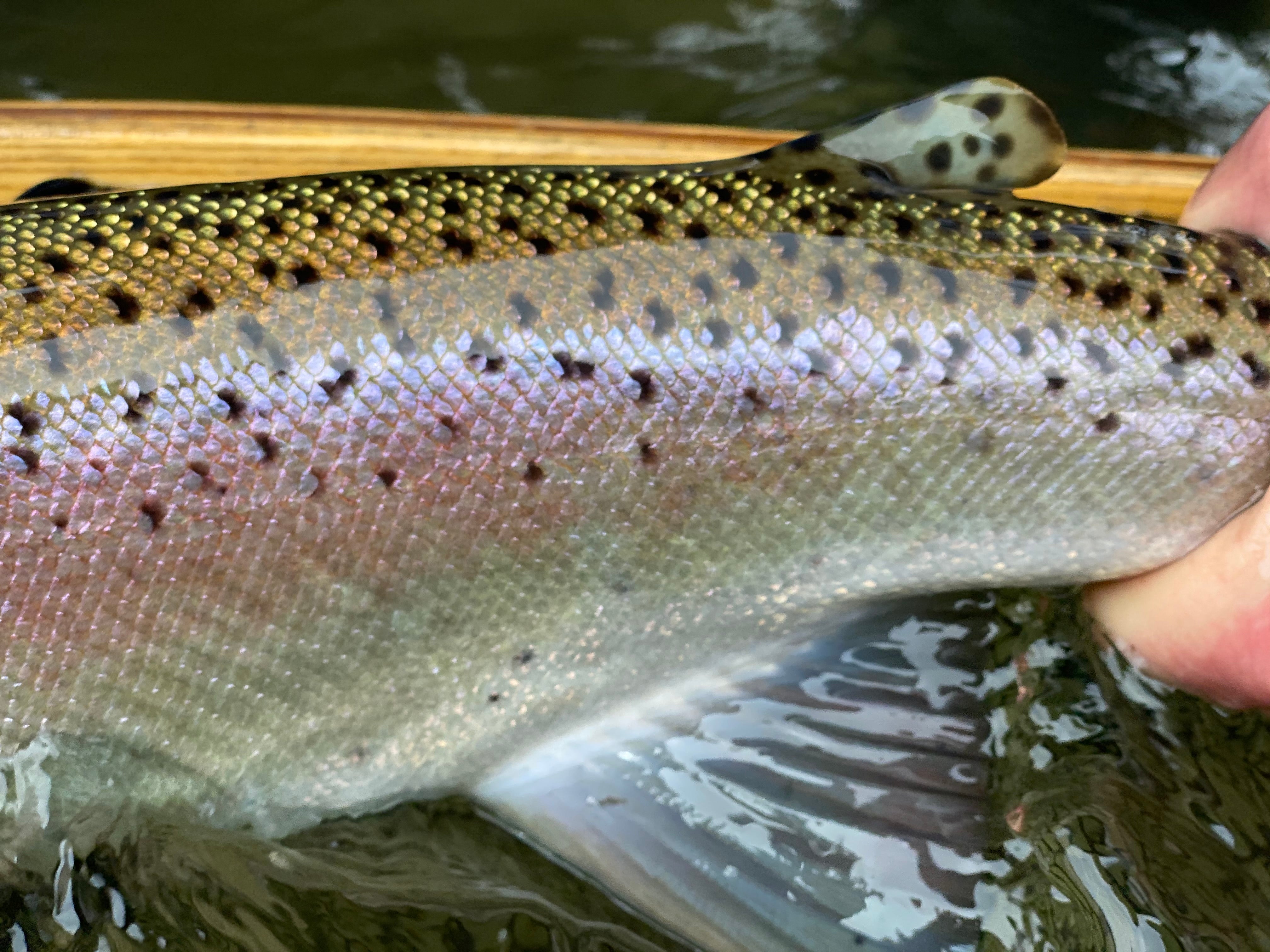
Trout were very happy when we were out on the water this week - probably in large part because most people are targeting steelhead! I saw trout rising all morning and really chowing down around noon when a small mayfly hatch came off. I couldn’t catch the mayfly to identify the species, but it was small and pale and likely a pseudocloeon - a tiny fall mayfly in the Baetidae family (same family as the more familiar Blue Winged Olive).
We saw rising trout up until we pulled the boat out around 12:30 PM. The morning risers were sipping caddis, mainly dead caddis, but some live ones too. Later in the day, just before we pulled the boat off, they were steadily rising in the foam lines below the trees - chowing down on pseudocloeons. Since John and I were steelhead fishing, we didn’t bring any trout gear with us that day. When you are on a big game safari, you don’t put down your big gun in order to shoot a few rabbits with the pellet gun.
Besides the good dry fly fishing for trout, fishing streamers down deep and tungsten beaded nymphs down deep has been the ticket for the trout anglers lately. Warmer water temps, due to the hot air temps we have been experiencing, make the trout seek the coolest places in the river - so you have to get your fly into the deep dark holes in order to find some of the biggest trout.
Most anglers are out on the water searching for steelhead. September is one of our prime time months for steelhead fishing the Deschutes because the numbers of steelhead turning in tot he Deschutes from the Columbia River usually hit their peak in mid-September. We need the weather and the water to cool down quite a bit, because steelhead fishing has slowed down considerably since the heatwave hit us. When water temperatures near the mouth of the Deschutes are warmer than the water temperatures in the Columbia River, steelhead are not inspired to enter the Deschutes. On top of the water temperatures challenges, the steelhead are facing a gauntlet in the Columbia River between line anglers and the gill nets that the tribal members have strung from Bonneville Dam to the mouth of the Deschutes and beyond. When the tribal nets are in the Columbia, it can feel as if someone shut the door to the steelhead migration into the Deschutes. A few skinny “net runners” (small enough to slip through the mesh and scraped all to hell by the nylon nets) are often the only steelhead we encounter, if we are lucky enough to encounter any at all.
At some point, and we have no published schedule for when the nets are in and when the nets are out, the tribes have to take the nets out of the Columbia and that usually opens the flood gates for steelhead to rush into the Deschutes. We see pulses of steelhead throughout the fall - numbers go up and down depending on the tribal netting schedule. All you can do is keep your fly in the water and keep on fishing - you are bound to make the connection at some point.
There are a lot of new signs along the river, at the campgrounds and at the boat launches. It is nice that the general public sees these signs and is made aware of the many rules that are in place on the Deschutes River. Here is a photo of one of the signs:

Know the rules before you boat or camp on the Deschutes River!
John and I had the float pretty much to ourselves the other day - we put on in the dark and picked our runs strategically all morning as we floated down river. John did not do much fishing, he worked through one piece of water for about 20 minutes in the mid-morning, and he had me fish all the other runs. I fished 10 pieces of virgin water between 6:00 AM and 12:00 PM without so much as a boil, a tug, a grab, a hookup, or even a sniff. It stayed cloudy for 90% of the day, but the sun was trying to burn through near the end of our float and I has a sink tip on to get the fly down for the last two stops. When the sun is shining on the back of your head while you face downstream to swing flies, you better get the fly down a couple of feet so that the steelhead can see it and won’t be blinded by the sun. Before I switched to the sink tip because of the sun, I fished a Scandi line and a long floating leader with either a skater, a muddler, or a classic hair-wing pattern.
I fished a lot of great water and I fished it well - but that doesn’t mean anything if the steelhead are few and far between or simply not in the mood to grab a fly. Neither John nor I touched a fish, but I did replay in my mind many great steelhead memories that happened to me or to my clients in each of the spots we fished. As my fly came closer and closer to a particular submerged rock, or swung over a depression in the substrate that has, over the years, been almost an automatic fish-on, I relived in my mind huge boils and vicious grabs, screaming Hardy reels, line ripping off down river, and jumping chromers throwing water like sparkling diamonds in the sun. Each step down river and each Spey cast felt like seeing an old friend after a long absence. The best thing about the day was the chance to fish with my favorite fishing partner, my husband. We so rarely carve out a day for just the two of us to fish the Deschutes together, it was a real treat to do so. We are usually so busy with the fly shop and with guide trips (sorry, neither of us are taking new clients anymore), fishing with each other for fun is a special day.

John had to hold the boat while Lupine was rowing.
We just got a shipment of custom-tied steelhead flies into the shop and we will have them in the fly bins today. These include the Lum Plum in size 5 and size 7, the Engagement in size 7, and the Addison in size 7. These are all patterns on which we have had great success over the years and they each have a nice story behind them - which I will not go into here. As I have said in the past fishing reports, it isn’t so much the fly that matters, it is much more important that the angler have confidence in the fly he/she is swinging. John Hazel’s famous quote is, “Steelhead will eat your car keys when they are in the mood.”
I wish you all a great weekend! Lots of folks are floating from Mack’s Canyon to the mouth of the Deschutes this weekend since it is the second to the last non-jet boat weekend of the year.
Have fun on the water, be respectful of other anglers, take care of our canyon by keeping your camp tidy, and watch out for those buzztails!


4smcmb
s11hme
s11hme
My family moved out here from the east coast back in the 70’s and I started fishing the Deschutes soon after as a youngster. We were told back then that the native people were responsible for the lack of steelhead in the river. I believed it and I grew to hate the native people for this. It wasn’t until I grew up and read enough to understand the atrocities that were wrought on the people that lived along the mightily fruitful river as well as overfishing, pollution, climate change, dams, poor forestry practices that I began to understand how wrong I was. Anyone now has quick access to this information on the internet. You can practically see a fish killing dam from your office! I don’t fish the river as much as I used to but somehow I hoped that things had changed and that fisherman and especially the outfitters had a certain knowledge and respect of the wrongdoings of the past and the people those atrocities were inflicted upon. I have a feeling you know as well as anyone that the native people have as little to do with the decline of salmonid species on the west coast as Trump/Bentz will have to do with rebuilding the once great fish runs. I guess it’s just your seeming lack of concern that some young fisher folks will read this and believe this hate you have chosen to spread.
Sounds great glad im not there