
Our steelhead fishery closed on August 15
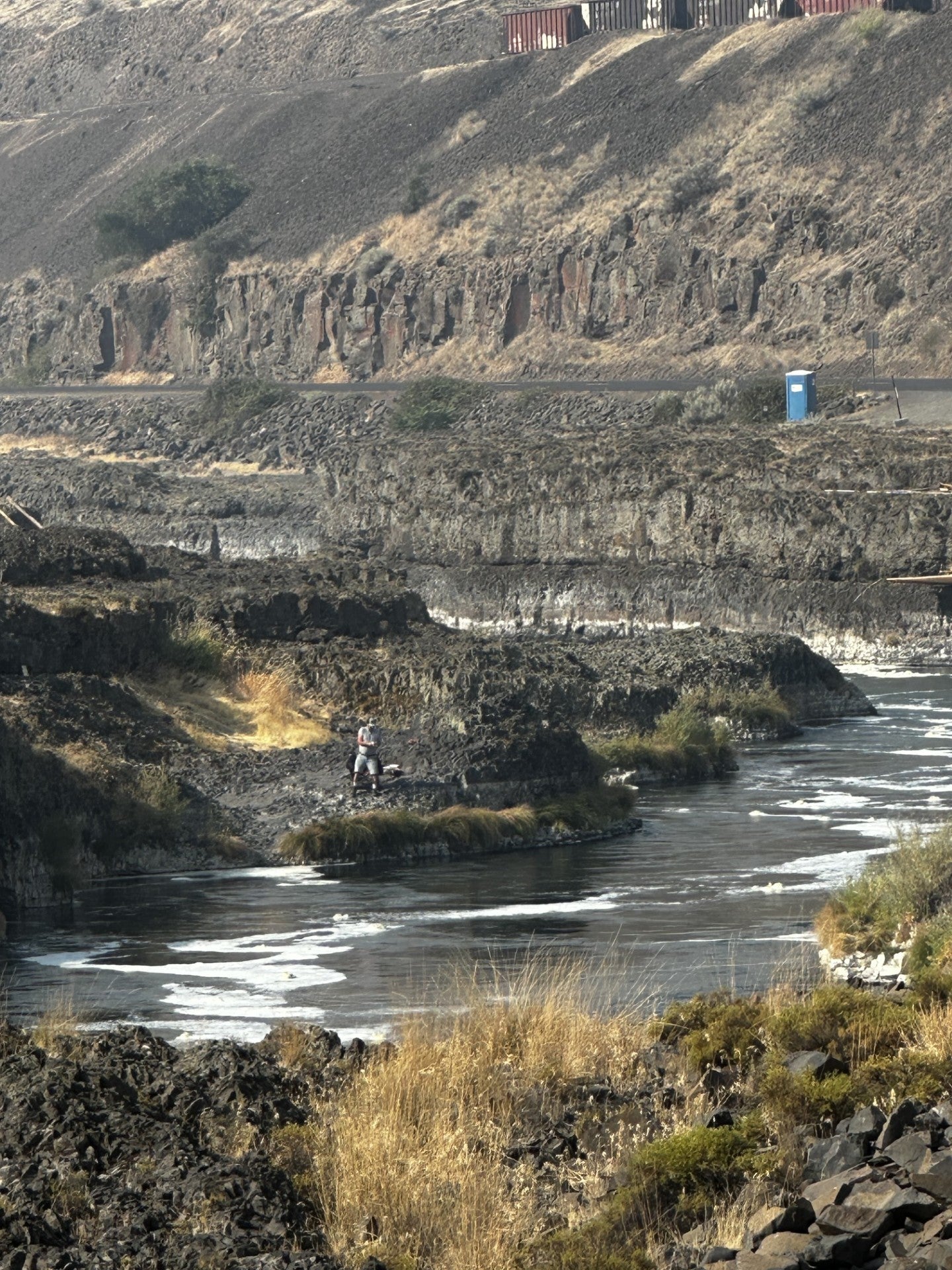
Sherars Falls is the point where they count, or miscount, the wild steelhead. The estimates of the run size will determine if we will be able to fish for steelhead in 2027.
Friday, August 14 was the last day of steelhead fishing on the Deschutes for the year - in all likelihood. We were hopeful that the numbers of wild steelhead coming over Bonneville dam would have a late surge, that maybe the fish were just waiting out the hot water before swimming further upriver. Unfortunately, that does not appear to be the case.
So, according to the framework set in place by Oregon Dept of Fish and Wildlife - there are only two things that could trigger the fishery to reopen.
- If we get a total of more than 23,100 unmarked (wild) steelhead over Bonneville Dam between July 1 and August 31, then the steelhead fishery will reopen on September 15. As the count stands right now, at this moment, we have 12,830 wild steelhead over Bonneville since July 1.
- If the count of captured wild fish at the Sherars Falls trap hits 120 on or before October 31, the steelhead fishery will reopen within 10 days of reaching 120 wild steelhead.
Let’s look at option #1 - this seems VERY UNLIKELY at this point. The peak number over Bonneville since July 1 was the 536 fish that came over on the last day of July. Currently, we are getting counts in the 200s and 300s. So, the September 15 reopening is a bit of a pipedream at this point. We have been keeping a daily total in the fly shop. As of today, we need 10,271 unmarked steelhead to pass over Bonneville in the next 16 days. That means that we need a minimum of 642 unmarked steelhead per day over Bonneville starting today (the 16th). DO NOT look at the YTD total on the fish passage center website - that number is much higher than the July 1-today number.
Now, let’s look at option #2 - it is difficult to say if this is likely or unlikely to happen, but there are certainly factors working against us for this number to become a reality. ODFW has a fish counting station at Sherars Falls which they do not operate 100% of the time.

The fish counting station - unmanned.
This counting station is at the top of two fish ladders and is usually operated at night when the steelhead are most likely to migrate. There is a gate at the top of the ladder (since we have low water this year, one of the fish ladders is completely dry and the one that has water in it is far lower than normal) which stops steelhead so that they can be counted.

Normally flowing with water, one of the two fish ladders is dry due to low water.

This is the only ladder with water in it for fish migration.
When the fish counter is not working, the gate is left open so that any steelhead using the ladder can continue its upstream migration (but those steelhead will not be counted).

This gate at the top of the fish ladder is open all the time, except the nights when the trap is manned. Wild steelhead that swim through will not be counted.
The main problem with #2 is that the most fit and strongest fish in the system are the wild steelhead. Long before the fish ladders were built at Sherars Falls, all of the steelhead were wild and were able to migrate upstream. The wild steelhead simply swam into and jumped up the waterfall. The wild steelhead that choose to use the waterfall this year as their natural migratory route will not be counted by the ODFW wild fish count.
Also - the counting station at Sherars Falls has another Achilles heel: it is not open for counting every day. Looking at the data collected in 2025 - there were 33 days out of the 107 days (July 15-October 30) that the trap should have been manned with an employee who counts the steelhead. There was no person on duty for OVER 30% of the time period in which steelhead counts determine whether we will have or not have an open season. The gate at the top of the ladder is open and wild steelhead that use the falls can move through this gate without being counted. Now, I realize that ODFW is not employing the best and the brightest, but you would think some employee could have dreamt up this idea: INSTALL A CAMERA at the gate to record the passage of wild steelhead and other salmonid species - particularly if you are going to have the counting station unmanned 30% of the nights and the gate is open all day long.

The wild steelhead count at Sherar's Falls is EXTREMELY IMPORTANT because it determines whether or not the season will be open next year. If the number of wild fish over Sherar's is estimated to be over 625 wild steelhead, then the fishery will start open next year. If the wild steelhead number over Sherar's Falls is estimated to be less than 625 fish, then the fishery will be closed until the numbers at Bonneville Dam in July either reopen the fishery or keep it closed.
The other HUGE problem is that ODFW is electing to keep the salmon fishery at Sherars Falls OPEN. This is not just open to natives, it is open to all anglers. In no other area of the Deschutes can a person target salmon, but they will be allowed to do so at Sherars Falls because ODFW will not be closing this section. This is a HUGE problem because this section of the Deschutes is the only section of the river where BAIT FISHING is allowed. Anglers sit on cliffs right below the waterfall and they dangle their bait into the water in hopes that it will be swallowed by a salmon. If a steelhead swallows this bait and is hauled in by the salmon fisherman, that steelhead must be released by the angler.
ODFW has recognized that there will be a BYCATCH of wild steelhead in this BAIT fishery and this is what they say about that: “Angling for coho salmon will remain open under permanent rule from the upper railroad trestle upstream to Sherars Falls. Steelhead are a bycatch in this fishery. Annual catch of wild steelhead by salmon anglers in this fishery is generally low with a 5-year average of 58 wild steelhead captured and released.”
I have MAJOR questions about this data. Nowhere in the fishing regulations or on a fishing license does it require ANY reporting of how many fish you caught and released. Unless ODFW has had a full-time monitor, or several monitors (as would be needed to patrol the 3.1 miles of river in which bait angling is allowed) there is no possible way that they have any idea how many wild steelhead have been hooked on bait and released into the river again. So, this 5-year average number is difficult to believe. However, let’s accept their data for now and just think about those 58 wild steelhead that will be impacted by keeping the salmon fishery open.
Bait fishing with barbed hooks is EXTREMELY lethal to salmonids. Studies show that salmonids hooked in the esophagus suffer 67.3% mortality compared to 2.3% mortality for jaw-hooked fish. Gill-hooked salmonids show an even higher 81.6% mortality. Other conditions that contribute significantly to the mortality of fish caught and released are as follows: the length of the fight, the type of hook they are caught on, the handling of the fish, and the water temperature.
Fish caught at Sherars Falls are often hauled up the side of the cliff, laid on the hot rocks as the angler tries to remove the barbed treble hook, then tossed from 15 feet up into the 66 degree water. A wild steelhead handled in this manner has very little chance of surviving that encounter with a bait angler. In studies with jaw-hooked trout, those released into 66 degree water suffered 40% mortality in contrast with less than 1% mortality when released into 60 degree water. Air exposure of over 60 seconds will kill a steelhead.
We have warm water temperatures in the Deschutes this summer. Hooking and releasing wild steelhead is risky even when the fish is played quickly and kept in the water as it is revived for the release. Salmonids are among the species most sensitive to water quality issues. PGE’s management of the water being released into the Deschutes has been a key reason that water quality has deteriorated significantly and water temperatures are several degrees warmer over the past 17 years.
In a 2026 article by Alfredo Ramses, which you can read HERE, the author outlines a bunch of reasons for catch and release mortality. The main conclusion is that the location of where the fish hook penetrates is a critical factor in the survival of the fish. Fish hooked on swinging flies are nearly always (I would say 99% of the time) hooked in the mouth or jaw. Using bait under a bobber on a floating rig (as fished in the bait section which will remain open) results in a lot more, if not most, fish being hooked deeply - in the esophagus or gills. The article states: “If you’re targeting salmonids in summer, check water temp before you rig up. If it’s above 18 degrees C, or 64.4 degrees F, consider switching species or locations. The ethical calculation changes when you know 8 out of 10 deep-hooked fish will die regardless of handling skill.”
So, if we were to apply the science to the 58 wild steelhead (a completely fabricated number which is likely far lower than the actual number of wild steelhead encountered by bait anglers) the conclusion is that roughly 40 wild steelhead will die at the hands of the bait anglers after being deep-hooked, poorly handled, and released. That is 40 wild steelhead that won’t be counted at the falls because they will be floating belly-up down river. That is fully ONE THIRD of the total number of fish that we need to be counted at the falls in order to open our season again.
It just FLAT OUT doesn’t make any sense that ODFW has ruled that the deadly bait fishery located below the waterfall is allowed to stay open.
Okay - steelhead rant over....for now.
Come on out and fish for trout - some of the very best trout fishing takes place in the fall. There are currently great hatches of caddis, aquatic moths, and BWOs. The trout are rising and you can pick them off in the foam lines.
The river is empty and calling your name!!


Well imagine that,here it is 10/01 and the wild are that low? Usually more wild then hatchery get counted the 5 days a month they actually do count.
Somethings fishy.
Amy can we get an updated trout fishing report?!
thanks
Amy is there a resent trout report ?
Well my thought is to follow the money trail, PGE has very deep pockets and appears the governor in one of them.. Where is someone like Vic Atieya when we desperately need them. Fix the lack of responsible politics and would go long way in fixing the Deschutes and restoring steelhead runs!
Hi Amy. Here’s my 2cent conspiracy theory on the topic: It seems to me that between PGE and ODFW, they are intentionally doing their best to eliminate the steelhead fishery from the Deschutes. The steelhead are the canaries in the coal mine that put the magnifying glass on the failing water quality generated by the PGE mixing tower. I also can’t help but think this effort has something to do with retribution for the good work the DRA is doing broadcasting those failures. And for some reason the Governor seems to be in on the scheme too, otherwise she could mandate a course correction at any time.