
Caddis Rule the Skies and the Trout
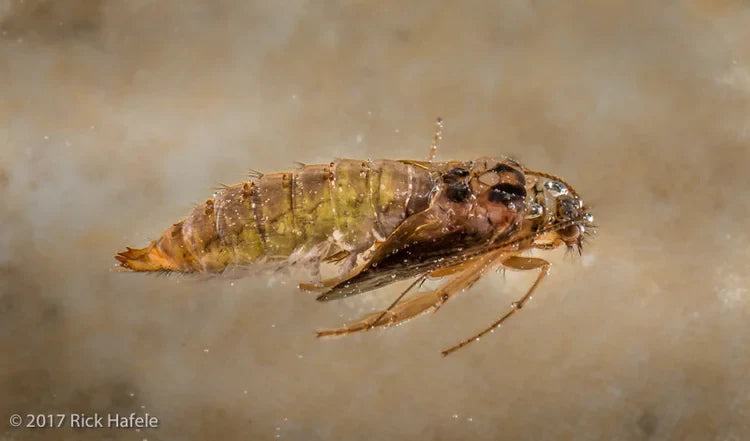
A Caddis Pupa imitation needs to match size, shape, color, and motion.
July is here and the caddis rule the skies! They also rule the menus of the trout in the Deschutes, who manage to feed on them throughout the day even though the hatches occur only in the evenings. To understand how to fish caddis hatches is to understand how to fish the Deschutes River - at least during any other month but May.
Everyone thinks that the salmonfly hatch is the only true topwater hatch that happens on the Deschutes, and that the rest of the year the trout fishing is nothing but a nymphing game. That could not be further from the truth. However, those of us who like fishing the Deschutes without the crowds are happy that so many anglers and so many Deschutes guides wrap it up and leave at the end of May. June gives the fish time to settle back into a comfortable feeding pattern without the constant harassment that the month of May brings.
Being a good trout guide or angler on the Deschutes requires a careful study of all of the insects that cross the stage during the calendar year. You need to know much more than just how to identify whether an insect is a Mayfly, Stonefly, Caddisfly, Midge, or Terrestrial. You need to understand the different species of each insect type and which species are important to the trout and the angler. Take the mayfly, for example, which most people know by shape - it’s the one that looks like a sailboat with a tall upright wing resembling a sail when the bug is on the water. It is also a beautiful, delicate, intricately designed organism that comes in many sizes and colors on the Deschutes and hatches year-round, even in the dead of winter.
You might be surprised to learn that all types of aquatic insects hatch pretty much year-round on the Deschutes. It is not uncommon to see adult stoneflies (winter stones), adult caddis, midge, and blue winged olive mayflies even in our darkest coldest months. When the trout are not sipping the dries and taking advantage of the insects in emergence, they are eating the insects in the nymph form - sometimes picking them right off the rocks.
So, what to know about caddis? How can an angler become a skilled caddis magician on the water? The first thing to know is that caddis emerge quite rapidly when they emerge from the bottom of the river. On the bottom of the river, where caddis live and grow for a year in their nymph, or larval, stage - caddis are hard little workers. Many build cases in which they will live and grow throughout their larval stage. Some live without casings and instead live as naked larva (like little worms) and spin nets which they use to catch food but also as a little shelter. Even though the caddis are in the larva stage the longest, the stage that comes in between living as a nymph and becoming a dry fly (adult caddisfly) - is the pupal stage which is the most heavily fed upon stage of the caddis.
In the pupal stage, the caddis are most available and most vulnerable to the trout - and this is also their most active stage. So, if you can tie or buy yourself some good imitations of the caddis pupa, you will starting down the road to hooking a lot of Deschutes trout.
Let’s explore which elements of a caddis fly imitation trigger the trout to take your fake fly amongst a sea of the real McCoy…. Size, Color, Shape, - these are the obvious characteristics of fly patterns that seem very important when you are hovering over the fly bins in the shop. The size is extremely important - it gets more critical to match the size as the insect gets smaller. A trout will be more selective between a size 16 and 18 than they seem to be with larger imitations of, say, stoneflies, which we fish in sizes 4, 6, 8, 10 without seeing one size as more productive. Male and female stoneflies are often falling into the water adjacent to one another and the makes are quite a bit smaller than the females. As the fly size shrinks down to a size 16 or 18 caddis pupa, the trout will selectively only eat flies in that very small fly size window.
Yes, I know, I hear it all the time in the shop: “I can’t fish a fly THAT small! I don’t know how I would even be able to tie it on! Give me the same pattern but in a size 12 - that way I can SEE it and tie it on.” I am thinking to myself, get a pair of magnifying glasses if you can’t see to tie it on. Or, sit at home with a really good light and a magnifying glass and pre rig some of these small flies onto your tippets so that you only have to tie a blood knot to add the fly to your leader. Do you think that the old timers who fish the chalk streams in England, or the spring creeks in Pennsylvania, or the San Juan River in New Mexico fish size 12 flies because that is the size they can SEE? Hell, no! Those anglers, some well into their 90s, manage to fish size 24, 26, 28 dry flies and emergers because they have to MATCH THE HATCH in order to catch fish. We have it EASY on the Deschutes compared to the technicality of fishing some other rivers around the world.
The smallest fly we fish with any regularity would be a size 20 Blue Winged Olive imitation. We do have lots of midge that are WAY smaller - but they are so tiny that they do not make a hook small enough to imitate one midge. You can tie up a griffith’s gnat in a size 20 which represents a cluster of midges gathered in a clump on the water - but you cannot imitate one of our tiny size 99 midges that we see (or don’t see) on the Deschutes.
So, if you are shopping for flies in the shop and the angler behind the counter points to a size 16 fly or a size 18 fly - they are not suggesting it as an annoyance to you with your poor up-close vision. We suggest flies based on what we know has been working for anglers, guides, and for us in recent days. If you don’t want to fish a tiny fly - don’t. Nobody is forcing you to match the hatch.
Back to the discussion of SIZE, SHAPE, and COLOR when choosing a caddis fly imitation. The size is a trigger to the trout as is the shape of the fly. Caddis do not have tails, so a general pattern like a Parachute Adams will not fool trout into thinking it is a caddis because the long tail, slender body, and upright wing all suggest mayfly as a shape. Caddis are tailless, squatty bugs that lift off the water almost immediately upon getting through the surface film.
Now, the color of a caddis is important to incorporate into a fly pattern with the correct size and the correct shape. Most of our summer caddis on the Deschutes tend to be either olive/light olive-green or cream/tan with a smattering of brown caddis as well as black bodied micro caddis. The orange-bodied caddis in the fall are called October caddis.
If you stick with a green or tan caddis in the summertime, and you are willing to cut off green and tie on tan to check the efficacy of tan versus green - then you are on the road to catching a lot more trout on the Deschutes in the summer.
What else is really important to the fly imitation besides size, shape, and color? The action of the fly in the water. Now the action that any one fly has will depend on two factors :
- The pattern itself and the materials incorporated into the design.
- The angler’s ability to make the fly move in the same way as the natural moves.
So, the size, shape, and color of the caddis pupa are now dialed in. Remember, we are fishing the pupa because the pupal stage of the caddis is the stage which is the most actively targeted by the trout. We have chosen a pupa in a size 16, the color is green, and the shape is tail-less, stout, and tied on a curved scud-type/pupa-type hook. What gives a fly movement before the angler gets involved? The materials out of which it is tied. A fluff of marabou will dance like crazy in the water, as will the flowing fibers of Cul du Canard - CDC feathers taken from the butt of a duck. Most importantly, the CDC fibers are super hydrophobic - water cannot stick to or get absorbed into the CDC feathers very easily. This causes CDC feathers to trap bubbles of air in their fine fibers and these bubbles exactly match the gas bubble that caddis pupa use to jettison themselves to the surface of the river when it is time to emerge. Seeing little trapped air bubbles alongside the materials in a caddis pupa imitation is going to make any trout swim a little faster to intercept the meal before it pops through the surface and disappears.
Often during the afternoon evening hatch of caddis, anglers become very frustrated because they can SEE trout feeding and they see caddis flying off the water, yet the trout won’t touch any of the dozens of adult caddis patterns the anglers present. The fly seems perfect in every way - and it is a perfect adult imitation - but the trout the SEEM to be feeding ON the surface are actually eating the caddis in their pupal stage IN the surface film and just UNDER the foam lines and scum lines.
As trout see the reverse-parachute activity of caddis pupa rising by the thousands from the bottom to the surface - they know that these bugs are easy prey and easy protein before they make their escape through the choppy water. Once they reach the surface, a healthy caddis might bounce once or twice and then it is gone and no longer available to trout as a snack. Caddis do not sit on the surface of the water waiting for their wings to dry - as mayflies do - so that upstream dead drift presentation that we learn to use for success during a mayfly hatch is simply the wrong approach to solving the trout puzzle when a caddis hatch is in full swing.
Often the most productive approach to fishing the caddis hatch is to cast a pupa straight across the river and let it sink in slack water. After a few seconds, allow a belly to form in your line as your caddis pupa imitation comes tight on your leader and begins to swing down and across the current. You can add a twitch here and there to give it more life, but that pupa on a tight line swing will entice many a trout to smash it before the swing is complete.
We have all had this experience nymphing: the flies dead drift through a deep slot and come tight below the angler dangling downstream. The angler takes a few steps upstream before making the next cast, and (while not paying attention to the dragging flies in the water downstream) WHAMMO! Fish on! There was nothing drag free about the fly that the big trout just smashed - and that is exactly the point. Not everything that a trout eats has to be floating drag free. Trout eat moving food like crazy if the moving food is abundant and offers an easier meal than any other insect stage during the hatch.
Try putting some action on your caddis this weekend. The pupa are most important during the hatch, you want to have a little variety in color, and CDC is a good material to trap air bubbles. Evening time is the hatch time. Morning time is the time to dead drift dead caddis - the legions of caddis that died during an egg-laying frenzy overnight. You do not want the dead caddis to be fluffy or lifelike or anything other than DEAD.
We have been seeing very tiny BWOs hatching off - they are all over our siding at the house every evening - but the sunny days are not always the best for robust mayfly hatches.
Streamers and deep Euro nymphing are still go-to methods for fishing fish in the mid-day. All fishing will get challenging during the absolute heat and bright sun part of the day - between 3-5 PM. If you take a fishing break, take one during that window. Stay out until dark - it is the easiest time for anyone to catch trout on the Deschutes.
Now, the low water and the hot weather, in combination with the mixture of surface water off the top of the reservoir (PGE tells us that the best they can do for cold water is 60% bottom draw out of the reservoir), is getting this river to become QUITE WARM every afternoon. The water temperature gauge in Maupin is reading around 66 and the water down at the mouth of the Deschutes where it flows into the Columbia is nearing 70 degrees daily. As these temperatures continue to climb, we as anglers need to be aware that fish fighting and handling need to be kept to a minimum. Fight fish as hard and as fast as you can, keep them underwater the entire time as you remove your barbless hook, have tools ready to help speed up hook extraction, use a rubber net to make the process of catch and release most efficient, and do not lift the trout out of the water to take photos.
Our government agencies are very slow to implement any regulations on the rivers that they (ODFW) feel might hurt their fishing license sales. ODFW is more worried about the health of their budget than the health of the native trout that live in the Deschutes. When the water gets into the 66-68 degree range, it is not safe to hook, play, and release fish. You will have a negative impact on their health. Carry a basic thermometer and know the water temperatures when you are fishing. Stop fishing at 68 - or even 66 degrees if you want to be very cautious.
IF the Oregon Department of Fish and Wildlife does their job of protecting trout and steelhead this summer, we are likely to see a Hoot Owl Closure on the Deschutes in the coming weeks. What that will mean is that everyone can get out and fish from dawn until 2:00 in the afternoon, after which time everyone on the river has to REEL IT UP and leave the fish alone in order to save their lives.
We do not have the HOOT OWL yet, but we will likely be seeing that on the Deschutes as well as on many other western rivers this summer.
As long as the river is hot, the steelhead will be hesitant to turn out of the Columbia and into the Deschutes. This is called a thermal block - and it is the reason that our once incredible steelhead opportunities in July have pretty much dried up and blown away. With the management of the water coming out of Lake Billy Chinook, PGE is purposely warming the river by mixing surface water with some bottom water, we are not likely to ever see that robust July steelhead fishery that we once had in the lower Deschutes. Some brave steelhead will still make the turn and head quickly up river in order to escape the warm swampy waters, but many will hunker down in the Columbia to wait for cooler days.
A few steelhead have been reported caught in the lower river, but FEW is the key word in that sentence. I had some friends float the river last week only to hear from the fish checker that only one steelhead had been reported in two days. If you want to get yourself on the board, you have to get out there and try for steelhead - and early morning is by far the best time to do that. They are coming…..


The Bonneville chart is rather scary