
Hot and Sunny Week Ahead
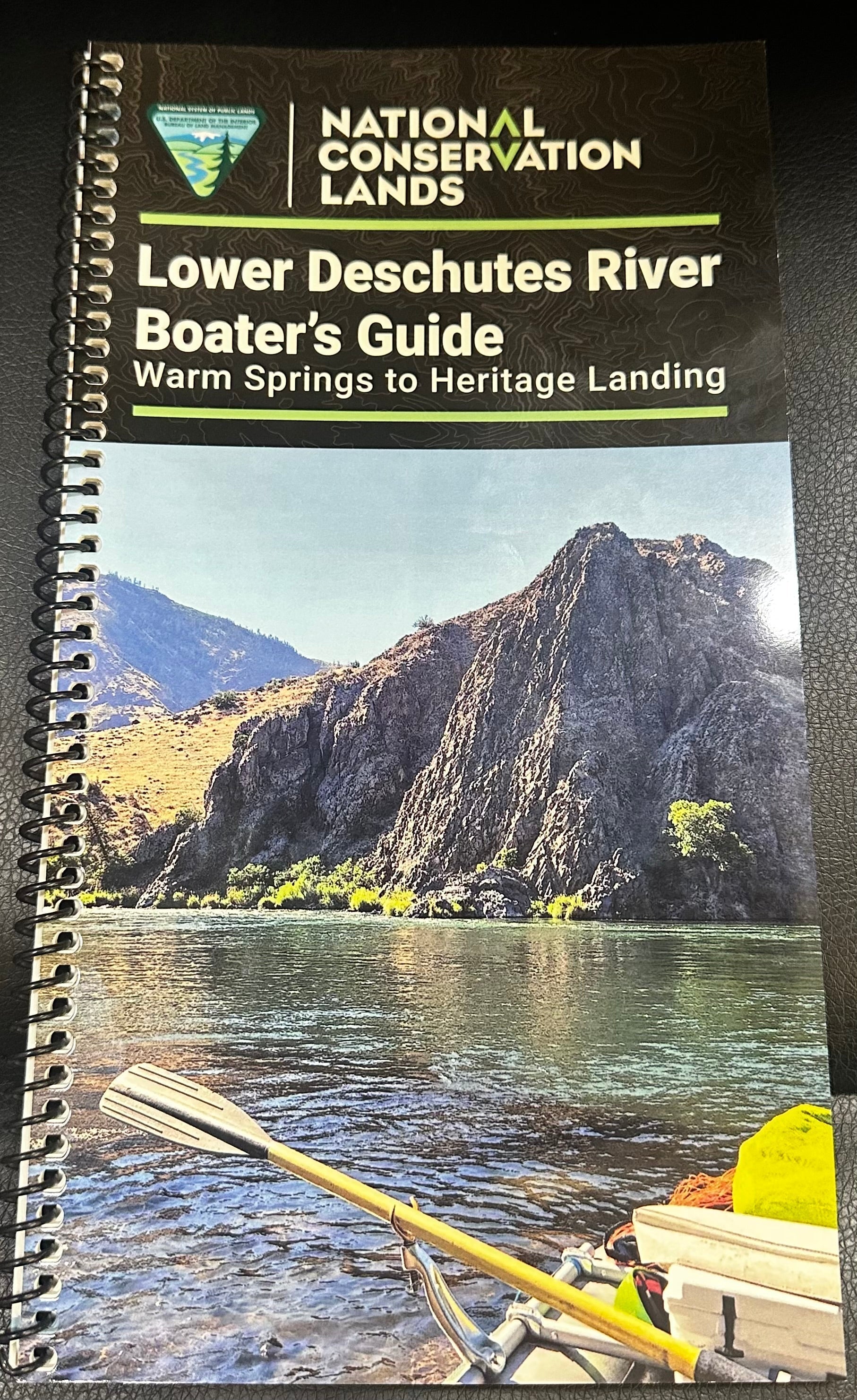
The BLM finally redid the BOATER GUIDE for the Deschutes River and we just got 100 of them in stock. They are printed on rip-proof, waterproof paper and offer a lot of great information to anyone floating the river. Each book is spiral bound. They show all the campgrounds along the river and even explain how to run some of the larger rapids. The campgrounds are listed in terms of which ones have good shade, and whether or not the landing is easy. The critters and birds that you might see on the river are listed, there is a botany section, a geology section, a bit of history, and a lot of information about fish.
Hot and sunny looks to be the weather of the next week or so ahead - today there is not a cloud in the sky and little to no wind in the forecast. This looks like an absolutely perfect summer day.
A few nights ago, we had quite a few lightning strikes in the area. Fires started all around us, but nothing is very close to Maupin. There is a fire between Shaniko and Antelope, a few fires on the John Day River, and there is a fire on the Warm Springs Reservation. These fires are putting a lot of smoke in the air, and the smoke has now blocked out the sun. This could actually be good for the river and the fish - the sun is what makes everything so darn hot. So, the day will stay cooler, but the night will be warmer with a blanket of smoke holding the heat in.
I want to make this very clear: Currently, we do not smell smoke in Maupin - the fire is too distant. The smoke is behaving more like high-altitude cloud cover. There is absolutely no reason to avoid the river, the smoke is more like a large cloud far away.
Our summer caddis hatches continue to be good. Hitting the river in the early morning hours and fishing in the evenings until dark will give you the best chance to hook trout on a dry fly. I have written exhaustively in the past two reports about how to fish caddis, so you can refer to my previous couple of reports to learn about caddis.
Let’s talk about the low water flows in the Deschutes and how that is impacting the current state of the river. We got a little sprinkle of rain since my last report and that might have given the river a slight bump in flow, but it is still well below normal flows for July. The low water tends to heat up more easily, which is why we are seeing temperatures at the mouth of the Deschutes over 69 degrees. This past week the temps at the mouth got to 69.5 degrees every afternoon.
These warm water temperatures in the Deschutes are very hard on fish - especially when they are played for a long time and handled out of the water after landing. The warm temperatures and low water flows are not only in the Deschutes, but they are in the Columbia River as well. High water temperatures yesterday at The Dalles measuring station were 69.9 degrees.
The warm waters in the Columbia are ideal for the non-native species such as Smallmouth bass and Common Carp. Those species are thriving under the same conditions that are stressing out our trout, steelhead, and salmon species. It is so warm in the Columbia that the steelhead that should be passing over the Bonneville dam fish ladder to the tune of thousands per day are a mere trickle - with only a few hundred passing each day.
We have been keeping a close eye on those steelhead numbers because there is a steelhead framework set in place by Oregon Department of Fish and Wildlife which determines whether or not we are going to have an open steelhead season on the Deschutes. It is a complex IF…..THEN type of framework that relies on the numbers of wild (unclipped) steelhead passing over Bonneville dam between July 1 and July 31. Here is the graph showing this year compared to last year and compared to the ten-year average:

It looks pretty bleak because the steelhead are simply not moving upstream through the super warm water in the Columbia River. They may be coming later, but the numbers that we rely on to keep the fishery open are slow going and we may see the steelhead fishery close on the Deschutes by August 15.
Currently, from July 1 through July 16 there have only been 2,606 wild steelhead over Bonneville dam. We have been keeping this chart in the back office because the numbers this year are going to determine if the steelhead fishery remains open.

The steelhead fishery, which is currently open to steelhead fishing, will close on August 15 if we do not get at least 9,900 WILD (unclipped) steelhead over the Bonneville dam by the end of July. That means that we need at least 521 wild steelhead per day to pass over Bonneville every day from today through the end of July. Those numbers need to get big and FAST.
The "key" numbers of wild steelhead over Bonneville Dam by the end of July are 9,900 and 18,700.
Scenario A: IF we get over 18,700 wild steelhead over Bonneville in the month of July, with the count starting on July 1, THEN the steelhead fishery will remain open for the year.
Scenario B: IF we get a number between 9900 and 18,700 wild steelhead over Bonneville in the month of July, the fishery will stay open but is still in danger of closing.
Scenario C: IF we have fewer than 9,900 wild steelhead over Bonneville dam in the month of July, the fishery will close on 8/15.
The counting of wild steelhead over Bonneville dam continues into August in order to follow through on Scenario B or C.
The important number for the July 1-August 31 count of wild steelhead over Bonneville dam is 23,100 fish.
If Scenario A happens, then we do not need to keep counting wild steelhead at Bonneville through the month of August. The fishery remains open for the rest of the year.
If Scenario B happens, then the count continues into the month of August, The count needs to exceed 23,100 wild steelhead over Bonneville in order for the fishery to stay open. If it does not reach 23,100 wild steelhead then the fishery will close on 9/15.
If Scenario C happens, and the fishery is closed on 8/15 - then the only way that it will reopen on 9/15 is if the wild steelhead count over Bonneville from July 1 through August 31 exceeds 23,100 fish. Otherwise, the fishery remains closed.
We went through this a few years ago - during COVID. The Deschutes was closed to steelhead fishing but it remained open to Salmon fishing. Lots of anglers continued to swing flies in the name of "fishing for salmon" and released all of their "incidentally caught" steelhead. At least the gear being used to fish for salmon was heavy gear that could play and land a steelhead safely.
If the river closes to steelhead this year it will also be closed to all salmon fishing as well. So anglers cannot "pretend" to be fishing for salmon with big Spey rods.
The trout fishery will, however, remain open.
If you are wondering how you can minimize your impact on fish during these hot summer days - there is an easy answer to that which will still allow you to pursue your love of fly fishing. Use a thermometer to keep an eye on the waters that you are fishing and impose a stopping point for targeting trout and steelhead. This is called a “Hoot Owl” measure when implemented by Fish and Wildlife - these measures are being implemented all over the state of Montana right now. Oregon will not implement such measures - they state that on their website - so it is up to individual anglers to self-monitor when it comes to stopping your fishing in waters that are 68-69-70 degrees.
A good plan for an angler on the Deschutes might be this: fish your early morning dry flies to the trout, or swing flies in the morning for steelhead. After lunch, as you see water temperatures climbing towards 67-68, you might switch to a local nearby fishery to target warm water species such as bass or carp. The Columbia River is an awesome place to find these species and they are quite a blast to fish for. I was out with my friend, Casey, last Saturday fishing for carp on the Columbia. It was a HOOT - and challenging as well. I got a hook into 5 carp in the morning and landed none of them. Wow, they are powerhouses. I also shocked myself by successfully hooking a sturgeon about 2.5 -3 feet in length (a baby). That fish came unbuttoned too. I was worried about using one of my primary saltwater rods for the carp - in fear of breaking it and not being able to get it repaired before my October Christmas Island trip. So, I was using a glass rod that is unbreakable and quite slow in action. Maybe I just wasn’t quick enough on the hook set with that slow noodle-like rod. Oh well, I still had a blast on the water.

"I will kick your butt!"
All along the Columbia River there are side ponds and accessible places to fish the big river. It is not as deep as you might think, and wading the river is super easy in a lot of places. If you have a boat or a standup paddle board, you may have an easier time getting around - the flats are mucky to wade in a lot of places. Just remember that the Columbia River does not mess around when it comes to high winds and waves - be sure to wear a life jacket.


Myself,@ friends, have opted, to cancel our Deschutes, reservations,@ seek steelhead, elsewhere.
If Scenario C happens, and the fishery is closed on 8/15 – then the only way that it will reopen on 9/15 is if the wild steelhead count over Bonneville from July 1 through August 31 exceeds 23,100 fish. Otherwise, the fishery remains closed.
If the steelhead fishery closes 8/15, what does it take for it to reopen?
Oh yeah! Glass is a blast. Especially for carp!
Does not look promising. Better fish while you can. The season is going to close, then the drama starts.