
Maupin is COOL!
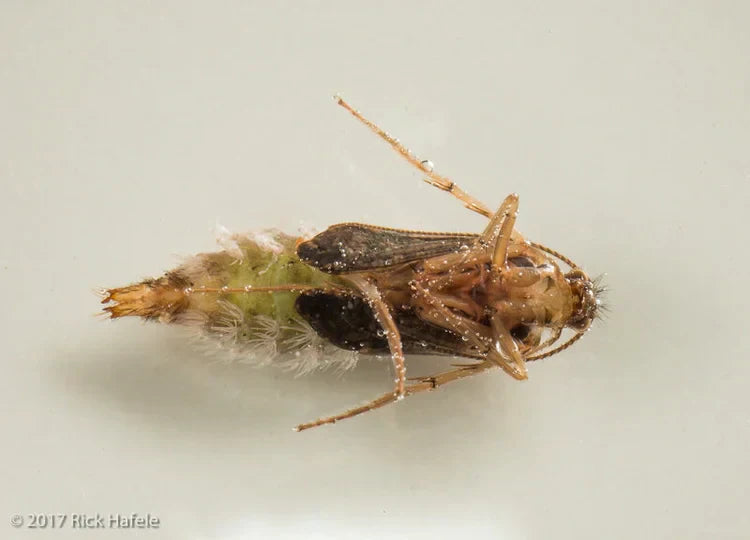
This is what a caddis pupae looks like.
I rarely get to report a cooling trend in the last week of June, but here we are. Things are cooling down dramatically for the weekend ahead and well into next week. We had a strong front barrel through the region last night, complete with high winds and rain. The earth soaked up that precious moisture - much needed in a dry year such as we are having. Since the earth is so thirsty, I doubt the little bit of rain that fell will have any impact at all on the river flow or color - the ground swallowed every drop.
The Deschutes is at an all-time low flow. In the history of keeping records on this river, which go back to 1897, the current flow of 3700 cfs is the lowest flow on record for this date. The average (median) flow for this time of year is 5000 CFS (represented on the graph below by the black line). Last year was another low water year, or so we thought, when the Deschutes was flowing at 4320 cfs on this very week. Now we are right around 3700 cfs, and even dipped to 3690 yesterday afternoon.

If you are floating the river you will notice rocks, that you would normally be able to float right over, are now exposed. Some rapids are going to be more imposing, with larger standing waves. Others will be slower to navigate, due to the low flows, and they may have quite a few more technical elements in the way of rocks to dodge.

At least the flows are steady and level, fish seem to be happier and more willing to feed when water flows are nice and steady like they have been. You know what else the trout really like? Cloud cover and even a sprinkle of rain. We have both of those elements today and tomorrow, which should bring on some excellent mayfly hatches. We still have a few Pale Evening Duns around, though they are now mixed in with the Pale Morning Duns - both hatching off in the mid-day despite the names that imply otherwise. The steady-Eddie of Deschutes mayflies, the Blue Winged Olive, will be mixed in with the PEDs and PMDs but is quite tiny (size 18) so have light tippet ready to fish these. As the rule goes, the smaller the fly, the smaller the tippet needs to be in order for it to seem natural. 6X tippet and a softer, mid-action fly rod are often the ticket for fishing this hatch. For every other mayfly hatch on the Deschutes, your 5X nylon tippet will get the job done.
I mentioned mayflies first in this report because of the weather forecast calling for clouds and a little bit of rain. Caddis, however, have been the main players on the stage for much of the month of June. We have been seeing very strong caddis hatches daily, coming on stronger as the weather has warmed up. Caddis hatches are great because they provide anglers with a game plan for the day.

Caddis are very active in the evening and just before dark - if you have ever camped along the Deschutes River, you know how thick they can be when you are trying to cook dinner by headlamp. You will get a lot of extra protein in your meal if you use the white light in your headlamp - that is why many headlamps now an option of a red or green light. Evening is when you will see a bonanza of caddis - which is exactly why you will want to hit the river early in the morning as the sun is just lightening the sky.
In the morning, the trout line the edges of the river to feed on dead caddis/spent caddis. These are the winged treats that laid eggs the night before and died on the water. The trout love the fact that they don’t have to work hard or hurry up to eat these snacks - there is no chance that they will fly off. Dead caddis patterns are available to buy, but they can also be created using the caddis that you may already have in your fly box. Start with a caddis pattern like an elk hair, for example, and trim the hackle off the belly to ensure that the fly looks stuck in the surface film. You do not want a high floater. In addition, you can splay the wings out to the sides by mashing the elk hair in your fingers to form a “V” of hair. If you are looking to tie a dead caddis imitation, simply dub a body onto a dry fly hook (tan or olive) and skip the ribbing and hackle. Throw a wing over the dubbed body, using CDC feathers in a clump or using a bit of dense fur from the foot of a snowshoe hare. It may look scruffy and it may land caddywompus when it hits the water, but that is the idea. Caddis do not look trim and pretty in death - so your fly should look more corpse-like than alive.
Once the sun hits the water, the feeding frenzy on dead caddis wraps up and the trout typically head to deeper water or heavily oxygenated riffles. With cloudy weather you will have the mid-day caddis hatch to look forward to - start fishing emerging mayfly nymph patterns around 10:00 AM while finding a good spot to fish the emerging mayflies. What makes a good mayfly spot? Any stretch of water below a good rapid or riffle. Look for foam lines. Foam is created by waves/rapids/churned water - and that is the exact type of water that mayflies use when they emerge. These upwellings and waves can help these tiny insect break through the surface film which they will then use to support their bodies as their newly unfurled wings dry out.
Nymphing during the day is quite productive. I like to use a stonefly nymph for good weight and use a second nymph (mayfly nymph before lunch and caddis pupa or green rock worm after lunch. I use medium-sized stonefly nymphs (the biggest stonefly nymphs in the river have already hatched out). The more moderate-sized two year old stonefly nymphs are now available to the trout in greater numbers than the very large ones that we do so well on in April and early May.
After the mid-day “will they or won’t they” hatch of mayflies, I concentrate on the caddis fly fishing for the afternoon and evening. Caddis are VERY active in the late afternoon - pupae are swimming and rising from the bottom, emerging in bursts. Fish tan or green pupa patterns for good success in the afternoons. Soft hackles can be very productive when caddis are the main players on the stage. Swing them in the surface film - let them swing with some speed.
Throughout the day you may see caddis bouncing up and down on the water and assume that they are laying eggs. I thought that too for a lot of years, but it does seem to occur randomly. I went to our extensive fly fishing library to read a bit more about caddis and found an interesting tidbit in the book, The Caddis and the Angler by Larry Solomon and Eric Leiser published in 1977. In the chapter titled, “The Adult Caddis, imitation and presentation” this information about the bouncing behavior was quite eye-opening:
”Again unlike most mayfly species which have a life span of only one to three days after emergence, the adult caddis may live up to eight weeks, and most have a life span of at least two. During most of this time they will not be readily available to the trout. But besides their vulnerability to fish at emergence and - for females - during ovipositing, the adult caddis return to the stream periodically for liquid nourishment, the only kind their adult mouth parts can take in. Trout are aware of this sporadic presence and thus may be taken by proper presentation of a dry fly during seemingly slack periods when there is no real hatch activity.”
So, I learned that caddis live far longer than I once thought - up to eight weeks - that is longer than many of the seasonal employees will live in Maupin this summer! I also learned that caddis have a functioning adult mouth (mayflies have neither a mouth nor a digestive system in their adult phase) which they use to get sips of river water when needed.
What the above except from the book tells us is that dry fly caddis are a good option for one who is “prospecting” for trout. If trout have been dwelling in the Deschutes for any length of time, they will certainly have seen the caddis dropping down to get a quick drink. Trout are opportunists, particularly those holding in fast riffle water.
In the evening, the egg-laying will begin and this is when the trout are truly caddis-crazy. Female hydropsyche caddis will dive underwater and swim down a bit to lay their eggs. Some will use a rock to crawl under the surface, but most will swim. A dry dropper rig with a caddis pupa dropper or a soft hackle “flymph” can do wonders during the witching hour. Don’t be surprised if you are only seeing the sporadic rise - many trout are working just below the surface to suck down as many egg-laying diving females as they can.
The yellow sallies are just about done, though they may be available further upriver. I think a trout anywhere on the Deschutes would still grab a yellow sally given the opportunity to do so. A foamy sally pattern is a good choice to suspend a dropper nymph.
We should be seeing some aquatic moths soon - these are caddis-sized moths with creamy white bodies. Their wings are not tented over their bodies like caddis, they are flat and “V” shaped like any common moth species. They are often quite abundant on the Deschutes through July and August.
Steelhead should be starting to enter the Deschutes, but they may choose to stay in the Columbia River where water temperatures are cooler than those in the Deschutes. Due to our low water and the water releases from the top of the reservoir (thanks, PGE) water temperatures in the Deschutes near the mouth are already close to 70 degrees. This weekend and early next week, we are getting a reprieve from the hot weather and should see the water temps drop for a few days. This is what we will need to get steelhead moving into the Deschutes.
We are likely to have some regulations this summer regarding water temperature. Hoot Owl closures are special closures imposed on rivers during the hottest times of the year. When a Hoot Owl is in effect, fishing may be allowed in the morning, but the river will close at a set time (sometimes 2:00 PM) after which time no fishing is allowed. Even catch and release angling becomes lethal when water temperatures approach 70 degrees.
Because PGE is pouring the water off the top of the reservoir into the Deschutes - I feel that it is important to share with you all that there is a water advisory for Lake Billy Chinook - but NOT for the lower Deschutes. There is a slight possibility, however, that some of the blue-green algae water is mixed in our Deschutes water because it all comes out of Lake Billy Chinook. If you have a dog with you on the river, it might be a good idea to bring fresh drinking water for your dog.

DAFS employee, Taylor, and her Golden Retriever, Wilbur.
This is the information about Lake Billy Chinook - which is the source for the Deschutes. Water in the Deschutes is, however, diluted quite a bit and doe NOT currently have any health or safety warnings. We have not heard of any people or pets having any issues with the water in the Deschutes:


Well, that’s the report for Friday morning. Hope to see you on the water.


main stem Umpqua 75 degrees
Andrew, the week prior to this report, there was almost two weeks with high temps in the river approaching 70. This cooldown has brought down water temps. Next week temps will be hot again, so highs at Moody will likely go back up to the high 60’s.
PGE doesn’t turn the cold water back on for a while. It would be nice if they could at least mix a little more cool water to bring temps down a few degrees.
USGS is reporting is temperature range between 60-64F @Moody. What method are you using to report the Temp (mean)? Also, what are the steelhead benchmarks that regulate the season?
Thanks Amy