
June - Possibly the greatest month for trout….
We are now cruising into June, which might just be the very best month for trout fishing on the Deschutes River. Why? What about that salmonfly hatch last month?
Yes, the salmonfly hatch was really good and really fun last month, but it is a VERY busy time on the river and the trout feel the pressure. Too many bugs slapping the water, too many people wading through their living rooms, intense pressure from dawn til dusk….it is just too much for a lot of the bigger trout. When pressured heavily, the trout get unhappy and stay down in the depths.
June is a month that pulls anglers away from the river, and the crowds of rafters have not yet shown up in Maupin. Many kids are still in school well into June, there are graduations, weddings, anniversaries, Rose Festival events, summer concerts, fairs, and many things going on in June that keep the crowds at bay. The weather is usually much more pleasant in June than in the heat of the summer months, and this means that water temperatures are more favorable (cooler) for the trout.
The pressure has now subsided, the campsites are much more open, some even empty, and the trout are moving back into their feeding lanes and starting to explore surface offerings once again. What offerings are available to trout now? Caddis, yellow sally stoneflies, a smattering of Pale Evening Duns and Blue Winged Olives (particularly on cloudy days). In addition to the hatches of dry flies, the subsurface activity is also excellent using nymphs as well as stripped streamers. Let’s break down a good approach to the fishing from dawn to dusk.
If you are an early riser, and you love being on the water as the sun is just peeking over the canyon walls, this is the time of year for you. In the colder months of April and May, not a lot is happening in the early morning hours, but that changes in the summer months when the caddis hatches really start to get intense. Caddis are extremely active in the evenings - laying eggs, diving under the water to do so, and mating in swarms all along the river. THe frenzy of activity in the evening along the water’s edge translates into strong early morning fishing if you are using a dry fly imitation of a dead/spent caddis. A dead caddis is motionless and laying on its side on the water. A dead bug is an easy, carefree snack for the trout, and you will see trout casually sipping dead caddis in the shady edges of the river. It is important that you choose your water carefully to avoid the sunlight on the water. Shade might be provided by a tree or bush hanging out over the water, but it is more often provided by the low angle of a sun that is blocked by the canyon walls. The water should have streams of foam coming down in speckled lines on the water and it should also have some chunky boulders and depth in order to be appealing to the largest trout.
The fly that you use to imitate a dead caddis is also key to your success. You can purchase flies that are tied to look like dead caddis, OR, (in the case that you just have elk hair caddis in your fly box) you can modify your elk hair caddis to make it look dead. Start by trimming all of the hackle off the belly of the fly - get that belly exposed to the trout. The lower it sits in the water, the better. The hackle is tied into an elk hair caddis to make it dance on the water and look alive - we need to trim that right down to the nubbin. Next, the elk hair wing should be split in half and worked with fingers and thumb until it splays out. You want that caddis to look like it just completed its lifecycle and splatted face first into the river as its final act. You could trim the wing down a bit, or even cut half of the wing off - just make a mess of the elk hair caddis until it is a convincing corpse.
When you present a dead caddis to a trout, you should do so with 5X tippet or smaller. 5X has a diameter of .006”. Thicker tippet will earn you rejection after rejection. Pound test is not what trout see, they see tippet diameter and the smaller you can go, the more real the fly will look to the fish. In most places on the river, you are best off with an upstream presentation and a completely drag-free drift. The trout must believe that the fly is dead, and is thus an easy snack requiring minimal work. Time your presentation with the foam - remember that foam is home for the trout. Rainbows look to the foam lines for their next morsel, because foam lines tend to trap dead insects and others that may be struggling to emerge. Foam lines or rafts of foam also offer trout a bit of cover and protection from avian predators, because trout are less visible to the ospreys and herons when they are hovering under a raft of foam inspecting it for bugs.
The trout will feed on dead caddis until 10:00 or until the sun is brightly on the water and possibly in their eyes. When that happens, the trout will seek darkness or shade - either up underneath tree branches or down in the depths. It is now a good time to explore the river with a dry-dropper rig. I would most likely tie on a yellow sally pattern with a bit of foam in the body. This bit of foam will give the fly better floatation and will allow the fly to hold up a trailing nymph. Many people ask me, how long should that dropper be off the dry fly? That really depends on the water that you are fishing. Sometimes that dropper is a mere 6” below the dry, while other times that dropper is 3 feet below the dry. It just depends on the water depth that you are fishing.
By noon, the sun is shining brightly on the water and this is a good time to do a little searching down deep for trout that are eating nymphs or chasing streamers. It is also a good time to take a little break for lunch, enjoy a nap (perhaps), come on up to the fly shop for some fly ideas, or tie a few flies for the evening hatch. The late afternoon and evening are the magical time on the river when caddis are thick.
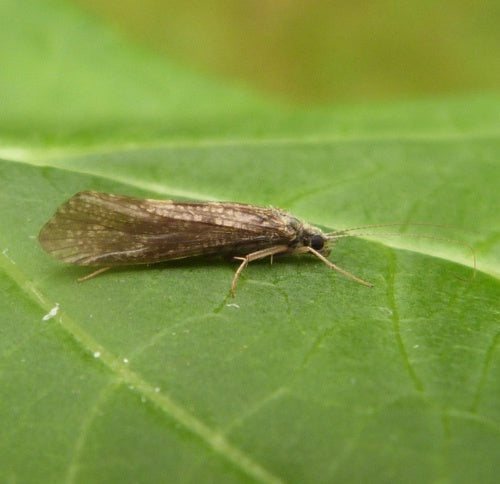
The main caddis emergence at the moment is the hydropsyche, or net-spinning, caddis. There are a couple of subspecies, which results in two main body colors for the caddis - some are cream and some are light olive. They live for about a year in the nymph stage - positioning themselves on rocks with fairly significant current flowing past. The current carries with it specs of food which the hydropsyche captures in small nets that is builds and anchors to the rocks. Much like a spider, the caddis nymph will feed on the bits that it traps in its web. When emergence is near, the caddis larvae will build a cocoon out of silk and will pupate inside. It takes about three weeks for the transformation from larva to pupa to take place, during which time antennae, legs, and wing casings grow and fully develop. The emergence generally occurs in the late afternoon - the pupae make their ascent to the surface and are carried downstream as they rise up. The adults quickly break free of the pupal casing, wings pop out, and the lucky ones take to the air and fly to the river’s edge. 
During this emergence, which takes place in fast broken water, the trout gorge on the pupae. Anglers will do well during hydropsyche emergence if they fish a true soft hackle in the surface film. Dropper nymphs like a Hare’s Ear in cream or green, Car Wash Caddis in cream or green, and LaFontaine’s sparkle pupa in cream or green, are all deadly patterns during the afternoon emergence.
By evening time, the fertilized females are back on the water to lay eggs. The key behavior of this particular caddis (and one that you should know about as an angler) is that the females do not simply plop eggs on the surface - they DIVE. They will crawl under water and lay their eggs in a jelly like mass. After the eggs are laid, the females swim back up to the surface with their wings trailing behind them. This makes the evening time in June a magical time to swing classic soft hackle patterns for trout. Tie soft hackle flies with and without beads in the thorax. The beaded version will allow the nymph to sink down a foot or so before the line comes tight and it rises up again. The non-bead version will lie helpless in the surface film, especially if fished with an upstream presentation and a drag-free drift. Hungarian partridge makes for the very best soft hackle. The natural speckles in the feathers are incredibly close to the look of the Caddis wings swept back on an egg laying female swimming back up to the surface.
When trout are feeding on emerging caddis, sometimes you will not see any rises because they are feeding in the mid-water column in deep water. If you are standing in a riffle that isn’t more than 2-3 feet deep, you are more likely to see the splashy rises of trout as they chase the pupae right to the surface and leap to grab the emerging adult. Fishing the caddis emergence in the late afternoon can be super productive on the Deschutes in June. Caddis love warm sunny days - so this upcoming weekend promises to be a fantastic one for caddis - as well as for yellow sallies.
Even though the salmonflies and golden stones are gone, their smaller bright-yellow to orangish-yellow cousins are here for the month and possibly into early July. The isoperla stones are commonly known as Little Yellow Sally stones - and, like their larger cousins, the trout love them. Since they are in the stonefly family, there is no emergence. The nymphs crawl to the river’s edge and crawl out before becoming adults. They mate and the females return to the river with red sacks of eggs in tow, which they will deposit on the surface. A bright little red butt on your fly will let the trout know that this is a juicy female and a prime snack during a warm spring/summer day. The bright yellow body is difficult for the trout to resist at this time of the year.
The moon phase is perfect, the trout are much more relaxed, and the weather looks to be mighty fine this weekend. We hope that you can make a trek to the Deschutes to catch some of our best trout fishing of the year.


Thanks for the great educational read. I’ll never forget a few years back fishing the tail end of the salmonfly hatch and catching 0 and feeling stumped. The coming back 2 weeks later in mid to late June catching well over a dozen fish including some absolute beauties in the upper teen inches all on tiny caddis flies.
Your report is pure poetry
Fantastic Report.
I skip the “big hatch” every year now. Staying in Maupin this Thursday through Sunday to fish. No problem getting a cabin at Oasis or a campsite. There’s a lot more room to fish and as you said, the fishing is always better in my experience. I love it. We’ll see you all in the shop soon!
when fishing soft hackles during magic time what color for the body of the fly do you prefer?