
Rain Coming on Sunday
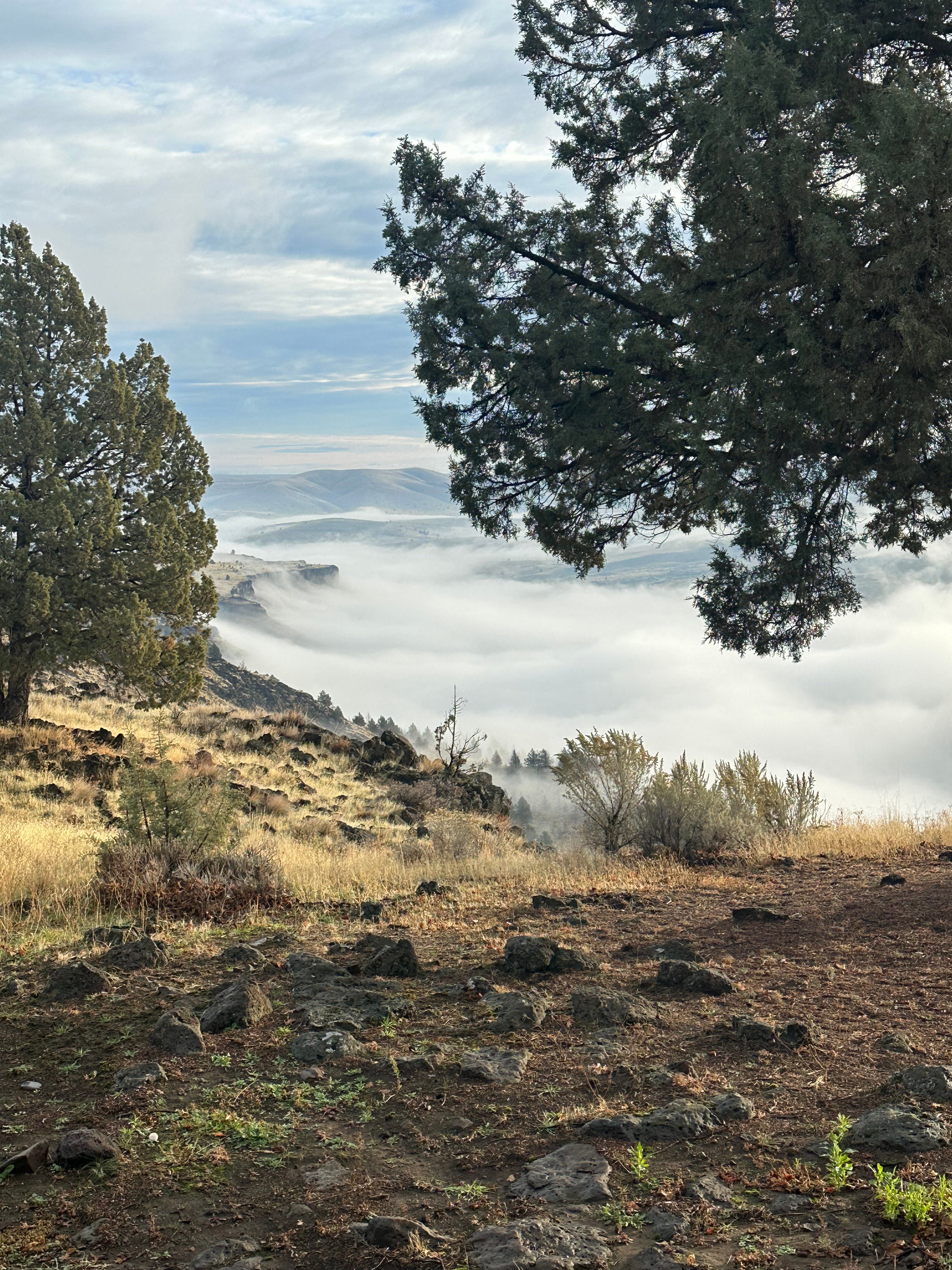
A view of the Deschutes Friday, November 14, foggy, cloudy and dead calm.
HOURS: Open Daily 9:00 AM to 5:00 PM (Open Sunday 9:00 AM - 3:00 PM).
My apologies - I wrote a fishing report last Friday and thought I had posted it, but I came to find out this morning that it was still hidden from the internet. Check out last week’s fishing report before reading this one. There is some information on that fishing report about some great deals we are offering in the shop. The fishing information in that report holds true into this week - conditions and fish behavior have stayed steady over the past week.
The incredible mild weather continues this year - which has extended the fishing season for many an angler on the Deschutes. We are forecast to hit a high of 59 degrees today, and the lowest low temperature in the ten-day forecast doesn’t even hit the freezing mark. This is not normal weather for November on the Deschutes. I can think back to so many late October/early November days with snow on the banks of the Deschutes, frozen hands and feet, ice in the guides, and water temperatures in the low 40s prompting us to have to use sink tips to put the fly closer to the steelhead to get a reaction. This weather is bonkers! Anglers are still getting steelhead on skaters because water temperatures from the dam to the confluence with the Columbia River are 52 degrees currently and have been that ideal steelhead floating line/dry fly temperature for the entirety of October and November. I don’t see any real frigid weather forecast for the next few weeks - so enjoy this while it lasts!
This is not to say, by any stretch, that the steelhead are at their peak right now. We are certainly near the end of the productive steelhead fishing window for the Deschutes. The fresh steelhead entering the system are few to none, and those that are here have settled into a waiting pattern to conserve their energy to last until the spawning season in the spring. We do not have a winter run on the Deschutes or on any Columbia River tributary east of Hood River, according to the scientists, which means that the fish that anglers were targeting in July-October during prime time are the same fish that are milling around now.
Contrary to what I can only surmise is the belief of many an angler who calls our fly shop to ask this question: “Where are all the steehead right now? Have they moved up above the locked gate? Are they at Warm Springs and Trout Creek?” The steelhead do not move through the river system in one big clump. They are not traveling in schools. Each small genetic population of Deschutes steelhead will eventually spawn in the same waters where they were born, and they mill around in November-March waiting for the chance to get to their spawning grounds. If we have a dry winter without much rain or snow, the steelhead will be forced to use the main stem of the Deschutes to dig nests and spawn - simply because the small desert tributaries will not get enough water to allow their passage. However, in most years the steelhead will be able to access the seasonal creeks to reach some gravel. Shitake Creek, the Warm Springs River, Trout Creek, Bakeoven Creek, the White River, and Buck Hollow Creek are the largest of the tributaries and most of these will hold water (some only in pockets due to the heavy irrigation by farmers) for the majority of the year.
What is amazing is that the really tiny tributaries running out of canyons like Oak Canyon, Jones Canyon, Wapinita Canyon, Nena Canyon, and others will get just enough water on most years to allow full-sized steelhead to work their way upstream to get to some spawning beds. Pools of water remain in these creeks all year long, allowing the juvenile steelhead (some of them) to survive until the next high water event. When the fly shop is closed on Sundays in the winter (we stayed open on Sundays this November because the weather is so welcoming to anglers) we have the time to go on hikes in many of the Deschutes canyons. It is amazing and so special to find several big steelhead in 6 inches of water a mile or so up a canyon on a creek so small that you can leap over it in most places. They may only have a window of a day or two to get to their spawning grounds, do their business, and get out before the water level drops so low that they would be stranded.
I almost hesitate to write about this because I know that there are unethical people out there that would break the law and mess with these wild steelhead. Wild steelhead are a federally protected threatened species and all of the tributaries except the White River are closed to fishing (Trout Creek is closed December 31 when the upper section of the lower Deschutes closes). If you get caught pitchforking steelhead out of a small stream (as a few of the ranchers around here told me they used to do as kids) or even harassing steelhead, you could lose your fishing license and face serious fines. Keep your distance and allow the steelhead to create more steelhead so that our children’s children will be able to fish for wild steelhead one day.
Not only are the steelhead more active in these water temperatures, but so are the trout. The trout fishing can be great this time of year - but they will not typically be holding in the same waters you find them in during the summer. Trout tend to move into slower water and back eddies where they can work minimally and conserve energy. The hatches right now are quite limited, we have good Blue Wing Olive populations and those are awesome on cloudy and rainy days. We also have about ten million tiny midges flying around - tiny white specks that get into everything - but matching the hatch will be difficult on the midges unless you find a way to tie on a size 99 hook.
October caddis have more or less finished their lifecycle, but they will soon be replaced by smaller size 14 and 16 caddis that stick around all through the winter. Contrary to what you might think about insects, they will hatch out all year long even if it is frigid and snowing. I have taken many photographs of BWOs blanketing a fresh layer of snow on the side of the river.
In “local news” John and Gabor just returned from a really fun fishing trip to Mexico. They hit the northern coast of the Yucatán where they were guided for tarpon in the mangroves. This is a trip that I am looking forward to doing one day, but John and I cannot take a vacation together and have not been able to for years because of our extremely demanding dog - Lupine. She is not happy when one of us leaves - so we don’t feel that we can leave her with a dog sitter. The old girl is 15, going on 16 years old and she pretty much calls the shots around the house and in the fly shop. Because she woke me up at 5:00 AM, I will be able to get this fishing report written before heading off to the shop.
Anyway, back to Mexico, this is a trip that John has been doing with his buddies for 4 years now and one that he describes as, “Culinary and cultural tourism with a splash of fishing thrown in.” They fly down to Merida, where they are met by a driver who takes them to Campeche. There, they have four days of guided tarpon fishing - targeting juvenile to teenage tarpon in the mangroves. Picture yourself casting a large popper with a nine weight - except you only have a small tunnel of open space in which to cast because you are surrounded by mangroves. Think of casting your fly through a window located at the end of a 40 feet or 60 feet hallway with nine foot ceilings. Accurate casters thrive in this challenging jungle fishery, while those who have not honed their casting skills will struggle.

Bob Shoemaker "threading the needle"
The tarpon smash top water flies as well as Clousers and other sub-surface streamers - and what an arial display they put on once hooked! These are very manageable-sized tarpon ranging from 5 to 20 lbs.

Splash down!

John Hazel on the ocean and in his “Happy Place”
If you have ever hooked into a tarpon over 100 lbs, you will know what it takes to bring a fish of that size to hand. I once hooked a tarpon that the guide estimated at 180 lbs, and I have to say that it wasn’t all that much fun once we got past the exhilarating initial jumping phase. I hooked it in a channel in the pre-dawn hours in Belize - we were waiting for the sun to light up the water so that we could get to the sight fishing. Two hours later, in the full heat and sun of the tropics, I was whipped. The worst part of the whole experience was when the guide asked if I would be willing to get in the water to be in a photo with the tarpon, because it was too big to haul into the panga. Of course, yes, I can swim and tread water, but let’s not get over our skis - this tarpon was still rolling and dogging me. Just after the guide asked if I can swim, I felt the hook slip and second later the line went slack. Drenched in sweat, I stumbled from the bow deck and into a chair and reeled up my line to find a tiny piece of flesh on the point of the hook. I was done for the day before the day even got started. So, baby tarpon have a lot of appeal.

Steve Light SENDING IT
The fishing part of the trip was good but not what the guys had experienced in years past due to the King Tides that were present during their 4-day fishing window. They all caught tarpon, but it was more challenging to find them due to the extreme tides. The guys said that they boarded the pangas(skiffs) in the morning by stepping down off the dock 6 feet, but upon their return they had to step down off of the boat to get their feet on the dock. The number of tarpon hooked on this trip was down a bit due to the extreme tides, and the average size was a bit smaller, but everyone had a great time and caught tarpon.
The one and only GABOR - the man behind the lens on all of these photos
The culinary adventure, however, did not disappoint. John rarely takes a fish photo anyway, so I only saw a few photos of the fishing part of the trip. I did see a lot of food photos, however, as well as photos of tequila and mescal with giant scorpions in the bottle. They were not eating just fish and rice or even just rice and beans, no no. Carne carne carne in mouth-watering heaps filled the dinner table along with ceviche, octopus, and prawns.

Prawn ceviche on the boat.

Snook anyone?

The Mexican host, Alejandro and his son, Pachin, showed these anglers a great time on and off the water. Above is a screen shot from a video of Alejandro cooking steaks.
We had cloud cover here in Maupin during the incredible Northern Lights display this week, which was disappointing. John and Gabor had an incredible show on Tuesday night as they were flying across the country on their way home from Mexico. They saw Northern lights out of the window of the airplane and got a few pictures, but it is tough to take a quality shot through the scratched up super thick windows of the airplane. Here is one shot taken somewhere over Colorado:

Aurora Borealis
Needing a little inspiration for my long winter of writing these weekly fishing reports, I had a wild hair this past week and made an eBay purchase of a lot of old Fly Fisherman magazines dating from 1978-1985. Some avid angler in Virginia carefully stored and maintained all of his FFM copies for all these years and sold me the whole lot for $99. This may seem crazy, like, who wants a bunch of old magazines that are all yellowed and mostly black and white? It turns out that I do! I have been pouring over these old issues, absolutely thrilled with the quality of the writing, the depth of information in the articles, and I have really gotten a kick out of the old advertisements.
Fly fishing is a really unique sport in this sense - those who have achieved the highest honors in the sport and who are the undisputed experts of their era (I guess you would call some of them the fly fishing pros) - have always been extremely accessible to the budding enthusiasts and novice fly anglers. I don’t know any hack golfers who can sign up for a day on the links with Tiger Woods or Scotty Scheffler at their side giving them tips on their swing or strategies for their chipping and putting. What casual club basketball enthusiast can call up or send an email to Michael Jordan or LeBron James to ask a few questions about shooting three pointers? The level of accessibility that the pros in our sport give to anyone picking up a fly rod for the very first time is actually mind-boggling when you think about it.
Checkout this ad from 1978. Talk about a lineup of instructors! What a deal!

Not only are these magazines chock-full of incredibly well-written articles from the pens (yep, they wrote them with a pen and ink - or maybe on a typewriter) of such legends as Russell Chatham, Roderick Haig-Brown, Ernest “Ernie” Schwiebert, John Betts, Dan Bailey, Lee Wulff, Lefty Kreh, Dave Whitlock, Mark Sosin, John Goddard, Mel Krieger, Fran Betters, Gary Borger, Art Lee, Jack Gartside, Charles Waterman, Doug Swisher, Joe Humphreys, Dave Engerbretson, Nick Lyons, Joan Wulff, Rick Hafele, Dave Hughes and so so so many more, they also harken back to a simpler slower time when information about the river came to anglers once every few months on the printed page. Instant information about stream flows, fish counts, water conditions, and hatches was a pipe dream so far off that it could not have even been imagined by this great generation of anglers and writers. To some of you, probably the people still reading this fishing report this far into it, these names will mean something. If you are, as I am, a lifelong student of our sport and one who embraces the history and the foundation laid down by all who came before us, you will recognize the greatness that walked among us at fly fishing trade shows or with whom we were able to rub elbows at our local fly shops or on a visit to Idaho or Montana.
I was so lucky to get into the sport when I did and to meet the anglers whom I met as a young, wide-eyed angler just back from a solo backpacking fly-fishing trip around the world in 1997-1998. At a fly show in Portland, just days after my last fishing stop in Argentina, I met legends of the sport whom I, in subsequent years, came to know as friends and acquaintances and one particular legend who became my best fishing partner and husband. John and I travelled the trade show circuit year after year - at first in a shared booth with Kerry Burkheimer (also a shared and cramped hotel room) and later with our own booth (and hotel room!) after opening Deschutes Angler in 2002.
At these trade shows it was common for me to be on the casting pond and have Lefty Kreh slide up next me to give me some pointers. We ate dinners and hung out with Jack Dennis, Mike Lawson, John Bailey, good old Norm Norlander who invented the Nor-Vise, Lani Waller, Kelly Gallup, Tim Rajeff, Simon Gawesworth, A.K. Best, Harry Lemire, and so many other very important contributors to the sport. It was so cool to step off the casting pond and have Joan Wulff compliment me on my tight loops - crazy! Anyway, I ramble.
Over the winter, I will be sharing interesting snippets with you from old magazines and books, because there is a wealth of knowledge in the pages and some really fun throwback advertisements.
Looks like we will have some rain on Sunday, which is needed for fish and farms alike here in central Oregon. Have a great weekend and thanks for reading this long-winded report.


We love this “rambling.” These stories are better than the reports, Amy. Always looking forward to them!
I’d argue I ramble more.Good report.
Great report as always! I have been fortunate to meet some of the big contributors to fly fishing at our local club meetings and other events. You and John are in that group. Looking forward to your snippets from the old magazines.