
Dry Fly Madness!
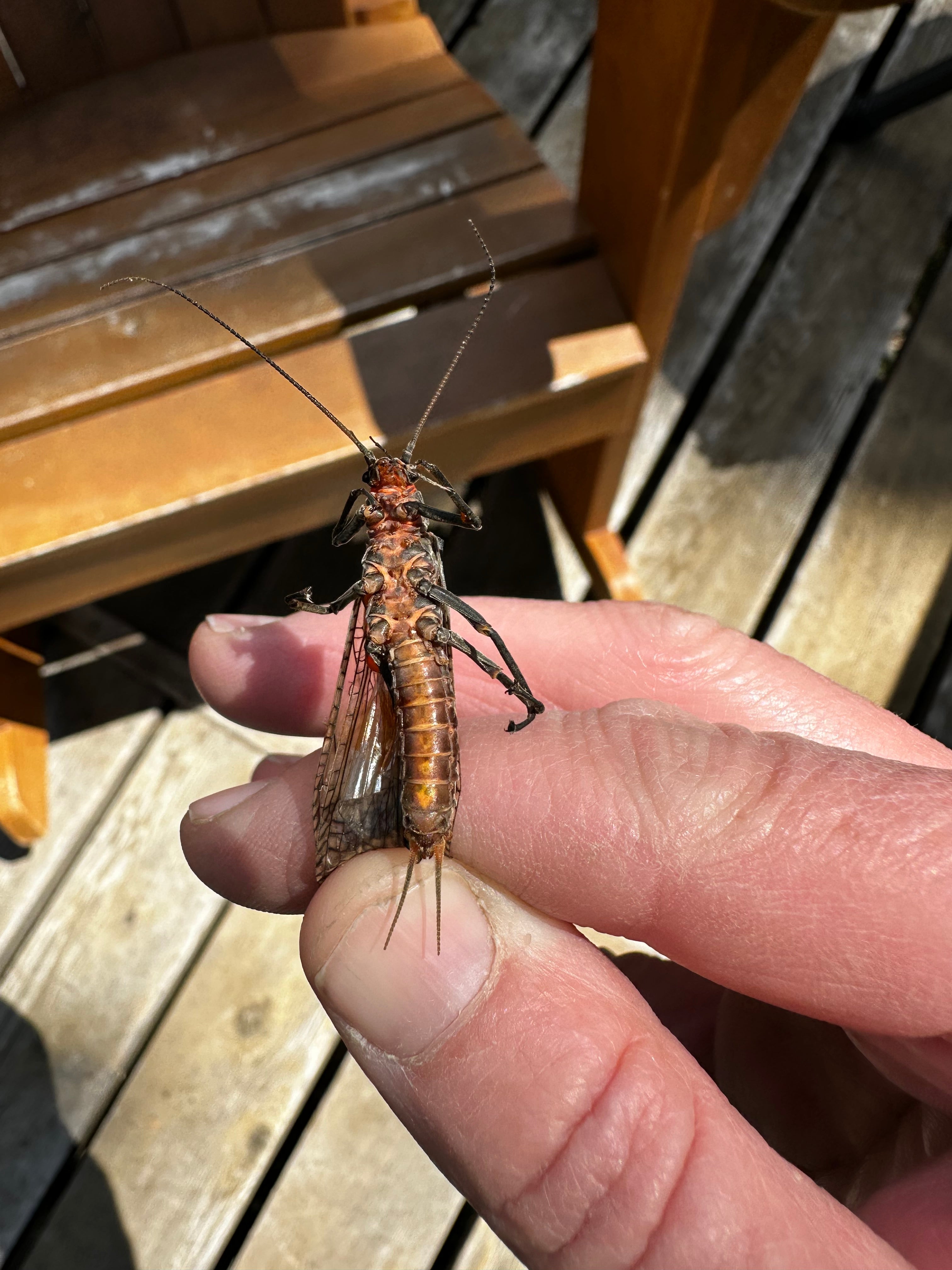
The last of the salmonflies have worked their way upriver and away from Maupin.
Good morning on a BEAUTIFUL Friday! Before I begin the fishing report, I have a couple of announcements pertaining to the weekend:
FIRES ARE ILLEGAL ON THE LOWER DESCHUTES RIVER STARTING ON MAY 13.
County Sheriff and BLM river patrols are out looking for campfires, people smoking outside of vehicles or off the river (you can smoke while standing in the water), open flames like portable fire pits, charcoal BBQs. There is a $1000 fine for having a fire and you can be held accountable for the costs of extinguishing any wildfire that you caused - into the millions of dollars. Use a propane BBQ, propane or white gass stove - these are allowed.
Many campgrounds are already full - and you must camp in a designated campground while on the river. You are not allowed to camp on the roadside in a vehicle. You should be able to find a site in Maupin - just keep driving down river. South Junction campground is completely FULL. Mecca Flats and Trout Creek are filling fast and may already be full.
It looks like Mother Nature is setting us up for a phenomenal weekend of great weather and fun dry fly fishing. The forecast calls for perfect and quite calm weather up until Monday night. Here is the 10 day forecast:

Memorial Day weekend kicks off the summer, but our bug hatches are a bit ahead of schedule due to the warm weather, warmer water temperatures, and lower water conditions. Nearly all of our important insects of summer are popping off the water now - adding variety to the trout’s menu. There isn’t a better time of the year to have success on dry flies, but you need to fish them in the right water types.
First off, the question that I hear most often on the phone is this: “Has the Salmonfly Hatch started?” Unless you have been living in a far off land for the past 14 years and not fishing or reading about the hatches on the Deschutes at all, or you are brand new to the sport, you should know by now that the timing of the biggest hatch of our season has shifted drastically. When I first started guiding the Deschutes in 1999, this is the time of year that we would really start seeing huge numbers of bugs in the bushes. This year, the bugs showed up in Maupin in the last week of April and were already heavy with eggs and ready to fly by the 1st of May. The early season hot weather helped to accelerate the hatch. Now, we are at the end of the hatch in the Maupin area - which happens to be the best time to fish the hatch. The END of the salmonfly hatch is the best time to fish it?
Yes, the end of the hatch should give you your very best chance to catch big trout on dry stonefly imitations. Why? Here are the reasons why:
- At the very beginning of the hatch, the bugs are in the bushes and are mating. Only on hot days do they get super active and piled upon one another in mating clusters along the river - to the point that they get sloppy and start to fall in to the water. At this time of the hatch an angler will do well only by getting into the tightest corners and accurately casting bugs up and under the trees and tight to the banks wherever the water is deep. The bugs fall out of the trees only on the windier days, and that makes casting accurately very challenging.
- In the middle of the hatch, when the hot weather has hit and the stoneflies are flying EVERYWHERE, it can be very difficult to be successful on dry flies because your fake fly has to compete with so many of the real deal. When the bugs come out in droves, so too do the anglers. The amount of pressure on these poor fish causes many to go into shell shock - and they are at their most alert and most selective at this time in the hatch.
- The trout are too full in the middle of the hatch - often puking up stoneflies because they ate more than they could digest. When they are full like this, you cannot force feed them. The dead middle of the hatch, with so much biomass available to the trout, seems like it would be great for the angler but it is often the toughest time to have success.
- By the end of the hatch (right now) there are only two species of stones that still matter to the trout, and the salmonfly is not one of them. The orange-colored big bug that the hatch is named after is actually the least important of the three stoneflies that make up the cast of characters that we know in “The Hatch”. Since salmonflies drop their eggs from the sky, and the golden stone and little yellow sally stone land ON THE RIVER to lay eggs, the trout are absolutely looking for yellow or gold when they target a big bug.
- The golden stone egg-laying happens EVERYWHERE on the river, and it does not require any kind of great casting or skill to huck a big bug into any foam line in the river. The trout spread themselves out at the end of the hatch and are no longer only hugging the banks looking for clumsy bugs. So, a golden stone pattern fished in any foam line on the river will be the ticket to fooling a big trout. Break out a Trout Spey and huck the bug to the middle of the river - and hang on!
- The end of the hatch means that you will not see a lot of golden stones in the air (though we are still seeing one or two flying around randomly) and you won’t see any more salmonflies in Maupin at this time. The trout HAVE seen them and are now going into a bit of a panic, knowing that the next bug they see on the water might be the last chance to get a big and easy meal.
So, this weekend may be the last big hurrah weekend to fish big bugs. The little yellow sallies will continue to represent the stonefly family on the river until well into June, as there are several types of yellow sally stoneflies (in the Genus Isoperla) that hatch on the Deschutes throughout late April-July, but they rarely get the play that their larger cousins get because they are “just another small bug” to most anglers.
There are a lot of “other small bugs” on the water these days, and anglers really should pay attention to what they are because they are going to make up the bulk of your next several months of dry fly fishing on the Deschutes.
I talk about these species in all of my previous reports, so I am not going to rehash everything I write about each week. Take a look at any of the recent blog posts before this one to see the info about bugs.
We have EVERYTHING hatching right now: caddis galore, pale morning duns, pale evening duns, green drakes, and maybe a few pink alberts, midge, blue winged olives, grasshoppers on the banks, it is ALL going on right now.
Of course, you can always do what you always do on any river because it is easy and you have found it to be successful, you can nymph fish. Nymphing is fun and productive - and it is certainly an easier road for a beginner angler to take in order to find fish. Nymphing at its highest and most technical levels - tight line nymphing - is more challenging to learn and takes time, practice, and skill to master. If nymphing is your jam, then stick with that until you feel that you have scratched that itch to hook as many trout as possible blindly fishing the depths. It is a skill to be great at nymphing, but a truly well-rounded master fly angler uses the nymphing gear as one arrow in his/her quiver and knows other methods of catching trout on flies.
One other popular method of hooking trout on flies is to streamer fish for them. This usually entails casting with skill in order to get the distance needed for a strong retrieve. You might fish streamer with a single-handed rod or with a Trout Spey - the Trout Spey is most popular on the Deschutes. We typically cast upstream and strip the streamers downstream on a sink tip and with weight in the streamer. It can be a lot of fun and a great way to search for big trout.
A final word for those of you who are new to the Deschutes - we have a lot of poison oak along the river and active rattlesnakes all summer long. Be aware of these things. Here are a few photos:

Poison Oak has glossy leaves and white/green berries. “Leaves of three, let it be.”

This is the average size of a rattlesnake on the Deschutes. Watch where you step and where you reach your hand. They are in grasses as well as on rocks.
I am going to wrap this up and get rolling into the Memorial Day Weekend! Have a good one and we hope to see you in the shop!


Amy Hazel is a gem who generously helps us all with her detailed reports, and I hang onto every detail knowing it will help me on the river. Can’t wait to come down this weekend for Troutfest.
-Eagerly awaiting the next blog!
Tori
We had to wait on hundreds of rookies, taking up river miles. Road side.splash and giggle……
I second what Clifton said. Thanks Amy!
Amy these are some of the best and most useful fishing reports I’ve ever had the pleasure of reading. And, you’re a very good writer too, you probably know that. Thanks so much for your excellent work!