
The “Hatch” Continues - with New Bugs Joining In!
Before I begin the report - I would like to share an announcement that the BLM put out earlier in the week: THE FIRE BAN STARTED ON MAY 12. Normally, the fire ban is in effect on June 1, but it is starting earlier this year due to the dryer than normal conditions. The fire ban applies to all campsites and day use sites along the Lower Deschutes River. No open flames (including Solo portable fire pits), no smoking unless you are standing in the river or inside of a vehicle, no campfires, no charcoal BBQs, etc. It is OK to use propane or white gas stoves and BBQs/cooktops that run on propane. The penalty is a fine of $1000 and the rangers will very easily and quickly find you when the smoke rises in the air.
Now, onto the fishing report:
As I wake to the sun rising over the river, the wind is already howling and is forecast to continue all day today and tomorrow with gusts up to 20 mph on both days. Sunday brings promise of a calmer day with winds under 10 mph - and partly cloudy skies. The clouds are exactly the welcome wagon needed to spur the latest and greatest hatch to grow a bit stronger. That is a clue - cloud cover - which I hope brings immediately to mind: MAYFLIES.
We have had this very windy weather since Wednesday and there are a lot of fly anglers out there who absolutely cannot stand it - hence, they stay in camp and don’t even try to get out on the water to fish. Yet, those who are braving the breeze, know how to approach the Deschutes, and have fished the river for years….those anglers are hooking a lot of very nice trout.
Brian Silvey stopped by the shop last night and reported that his fishing yesterday was off the charts good - with big trout eating both golden stones and PEDs. He also mentioned seeing the first Pale Morning Duns but very few Green Drakes in the stretch of river that he was fishing. Marty Sheppard stopped in to pick up more flies and he, too, reported excellent fishing with a really strong Green Drake hatch on Wednesday. Anglers fishing the road leading up to the locked gate have also been reporting strong fishing on golden stone patterns. I have spoken with anglers who have places above the locked gate and they, too, are crushing trout using golden stone patterns (they send photos of the patterns from our shop that worked the best) and mayfly patterns that imitate the adult PED (Pale Evening Dun) as well as Green Drakes. I have also heard reports all the way up river in Segment 1 that the hatch has finally arrived in the Warm Springs to Trout Creek section and the trout there are nosing the dry fly patterns, sometimes taking the big bugs, and eagerly eating the mayflies. I would say that that section of the river probably is in the middle of the stonefly hatch where we - downstream in Maupin - are at the tail end of the hatch.
When I say that we are at the tail end of the hatch (the salmonfly/stonefly hatch is the one which we refer to as “the hatch”) this does not mean that it is time to pack it up and move to an area of river where you are more likely to see a lot of bugs in the bushes. No. No. No. The tail end of the hatch is the very best time to fish the hatch because the trout are not completely stuffed with the real bugs. They have seen a ton of stones, particularly golden stones that have been egg-laying for weeks, and they are 100% keyed into the big golden bugs as a high-calorie food source. As the numbers of stones on the water get smaller and smaller, the trout get more and more eager to grab any that they find.
No longer are the trout concentrating their efforts on the edges of the river alone, they are now out in the middle of the river, in the riffles, and under any foam line that promises to deliver a stonefly snack. Now, their absolute favorite foods - MAYFLIES - have appeared on the water and they are happily taking a break from the big bugs to eat the PEDs and PMDs and Green Drakes.
Now, the above reports span an area of river from well below Mack’s Canyon, up river through the town of Maupin, all the way up river above the locked gate, past South Junction, past Trout Creek, up to the Warm Springs boat launch. In the fly shop we get to hear about the fishing all over the river, spanning roughly 90 miles of the Deschutes, so I am not merely reporting on what is happening here in the town of Maupin.
Last Tuesday I flew my new drone around the river a bit to capture the Golden Stone landing in the middle of the river to lay their eggs. I got some footage, but nothing spectacular enough to post on this report. I will keep trying to get some good footage to share with you - I just don’t get many days out of the shop during the madness of May.
On Wednesday the winds got extreme and the ambient temperature plummeted - which stalled out the Golden Stones a bit. They are not great flyers in calm conditions, so cold windy nights are the nights that the stones tend to sit tight in the grasses waiting for the next 80 degree day. Stoneflies are on hold at the moment - and the mayflies have moved in to take their turn on the menu. Colder weather and wind do not bother the mayflies much - and they absolutely LOVE the cloud cover, so the next couple of days will likely bring strong mayfly hatches and dynamite fishing. Here is the forecast:

The parts of this weather report that peak my interest are the bottom blue line (wind) and the middle section of light grey “mountains” which represent cloud cover. We LOVE cloud cover out here with the possibility of mayflies hatching. We don’t love the wind, but it is simply part of living on the Deschutes. Anglers who can adjust to fishing in the wind - and one of the keys to doing so is to move around on the river until you find sections that are less windy than others - will be rewarded with a bounty of bugs and some very happy fish. Sometimes it can be as simple as just waiting patiently, fly in hand, for the big gust to taper off. There are lots of windows within the windiest of days when you can make a cast and get your fly where it needs to be.
Sunday looks to be the least windy but also the sunniest - so the mayfly hatches probably won’t be quite as robust. There will still be mayfly hatches, however, and those take place in the middle of the day. They typically start off between noon and one PM and can last a full 2-3 hours on a cloudy day. On a sunny day or if the sun comes out, the hatch will end abruptly or it might just be very weak. In my opinion, to experience a strong Green Drake hatch on the Deschutes is the pinnacle of trout fishing for the entire season. These bugs bring every huge trout in the river to the surface to CHOW DOWN. The bugs themselves are huge and beautiful and oh so tasty. When you see them, you will be astounded by how beefy they are. Drunella grandis and Drunella doddsi- these two very similar species are what we have in the Deschutes, and these are not the same green drakes that you might find on other rivers across the west. Here is what a Deschutes River Green Drake looks like:

As you can see, the green drake has a very chunky body and an extremely tall wing. There are three tails that come out of that sausage of a body - so that (and the color) will easily set it apart from the other large mayfly of this time of year - the Pale Evening Dun (Heptagenia) with two tails.
All mayflies like to emerge in rapids or other roiling waters with lots of oxygen and lots of foam. They rise up from the bottom of the river and stay on the water’s surface for a brief period of time as their wings are drying. This is a very vulnerable time for the mayfly - and they are eaten voraciously during emergence by trout from bank to bank. If they are lucky enough to take to the air, the mating happens in a 24 hour window and they are back on the water laying eggs - completing their one day adult life cycle. If you see swallows (the swoopy birds with swept-back wings) picking things off the surface of the river, there is a very very good chance that mayflies are on the water. I saw swallows yesterday morning just above town going nuts in their mayfly feeding frenzy. Anglers who were smart enough to switch from golden stones to PEDs or Drakes are the ones who really cleaned up on the river.
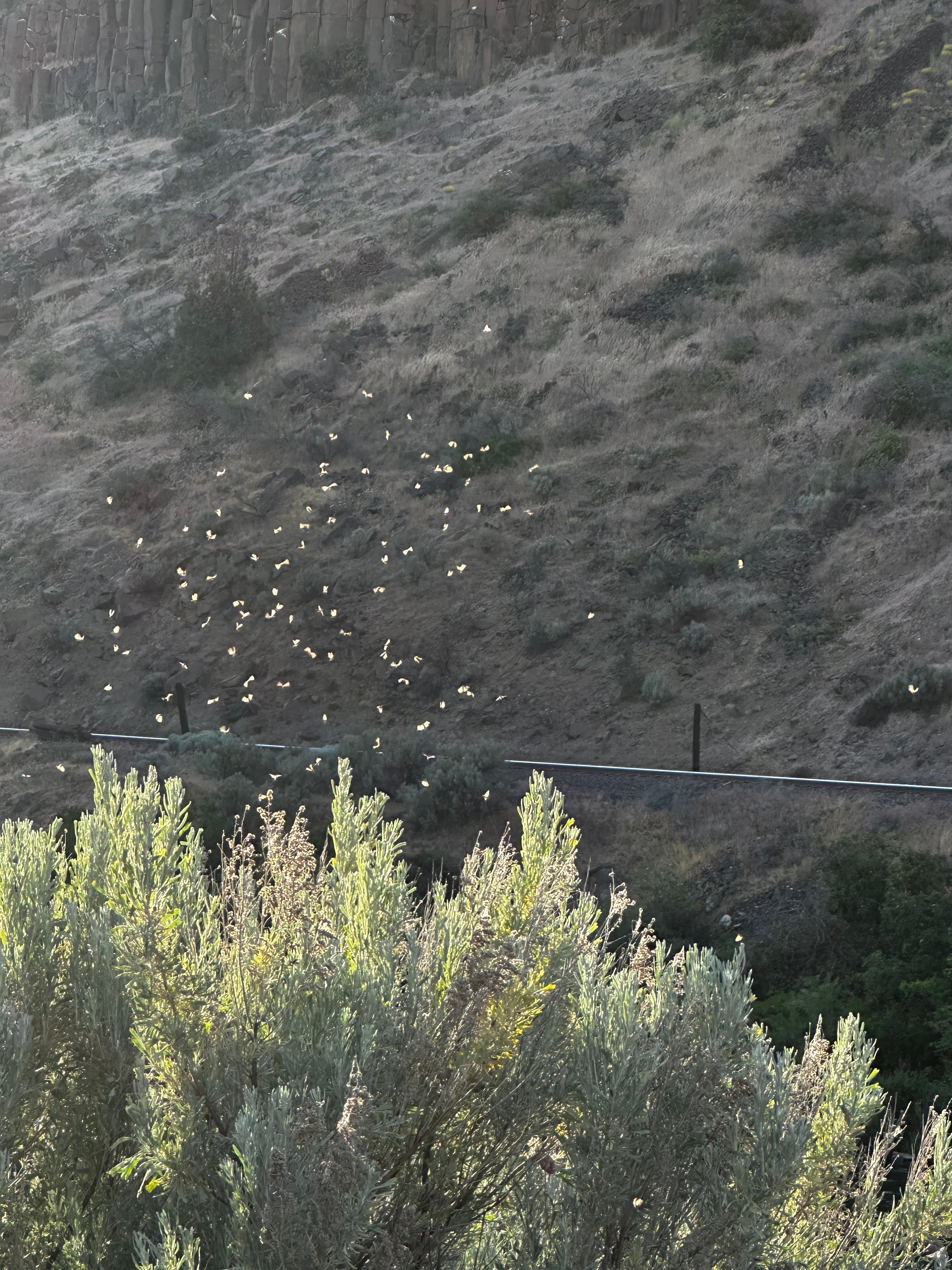
The opening photo in today’s fishing report shows the steady Eddie of the Deschutes - good old caddis. These are net spinning caddis (Hydropsychidae) which have been out in good numbers every evening. You will see them swirling over the sagebrush and you will find trout happily feeding on them all throughout the day - especially in the very early mornings and in the evenings. We sell a hundred different caddis patterns, and we are happy to share our favorites with you.
I will be in the store just a bit today and tomorrow, I have a meeting on each day and have to attend those meetings in person. We have a good crew on hand to help you get the right flies (and we have a ton of flies in stock) and the right tippet and leaders and whatever else you might need. Today’s meeting is the board meeting for Deschutes River Alliance. Tomorrow there is a meeting for key-holders and other invited groups like law enforcement and Oregon Department of Fish and Wildlife up at the Deschutes Club. During the time that this meeting is taking place, the locked gate will be left wide open. DO NOT DRIVE ABOVE THE GATE unless you were invited to attend the meeting. There will be a lot of law enforcement presence - BLM, County Sheriff, and maybe State Police too driving up and down that road above the locked gate on Saturday.

I know that many of you love to walk above the gate - it is very likely the most heavily fished 1-2 miles of the Deschutes near the town of Maupin. This seems to be the direction that every Portland area fly shop sends anglers - “Go to the Locked Gate” has been the “secret spot” that those fly shop employees like to give their customers. Unfortunately, it gets absolutely pounded by anglers walking up as well as by the hundreds of guided and non-guided boats floating down from Trout Creek. Yes, the fishing in this stretch can be very good if you are lucky enough to be the first or only angler to get above the gate. In the month of May you will never be the only angler above the gate. In fact, we often see 18-20 cars parked at the gate on a weekend day - which puts 20-40 or more people walking in to fish a handful of spots. The trout on the Deschutes do not respond well to that kind of pressure and are likely to be hiding out in the deepest pools with their eyes closed and their lips sealed tightly.
The locked gate might be the reason that you came to the Maupin area - you were given confidence in a named spot. It would benefit you and your fishing experience greatly if you ventured away from this area to learn and fish the other 40 miles of road access that the Maupin area has to offer.
One last word about fishing the Deschutes - there are a few things to watch out for while you are poking around in the search for trout. One is, of course, always on everyone’s mind: rattlesnakes. Yes, they are out and about. They do not want to hurt you, they only want to be left alone. However, they love the stonefly hatch as much as the anglers and trout do. You will often find snakes up in the bushes and the grasses and even the tree branches looking for snacks in the form of stoneflies. Be careful where you put your hands, make heavy footsteps while walking through the grass, do not reach your hand into areas like rock ledges unless you can see the area first, and do not walk through the grass when trains are passing by (you won’t be able to hear the rattle).

I won’t be of much help to you if you are bitten by a buzztail - other than letting you know where the nearest hospital is located (45 minutes from Maupin).
I CAN help you, however, if you encounter the other thing that “bites” anglers all the time on the Deschutes: Poison Oak or Poison Ivy. This stuff is EVERYWHERE on the Deschutes on both sides of the river and often on all of the trails that lead down to the best fishing spots. Leaves of three, let it be. Our poison oak plants can be 5 feet tall, with woody stalks and white berries, or quite close to the ground in a shrubby cover. Here is a photo:

Don’t ask me why that Salmonfly is getting it on with a golden stone - they are not even in the same family, which means that this is like seeing a cow mating with a horse. But they are safe on the poisonous leaves which are glossy and tinged with red/brown. 
One customer in the shop this week insisted that the poison ivy/oak does NOT grow on the track side of the Deschutes. I laughed out loud. This photo was taken on the track side.
If you tangle with this plant, you may be okay because some folks do not react to the oils. If you are not okay, or if you want to have supplies with you in your gear bag, stop into Deschutes Angler to pick up some Ivy-X wipes or to pick up a bottle of Tecnu Extreme.


Thanks Amy for the usual great fishing report and natural history of stream side life.
When, by the time you see this…we have spring salmon available to target below shears falls. To the mouth Ha. 20 th may . 5x out, 20x in. Oh and, you’re gonna need a bigger net. No bait Ha!