
Stonefly Madness in Maupin This Weekend
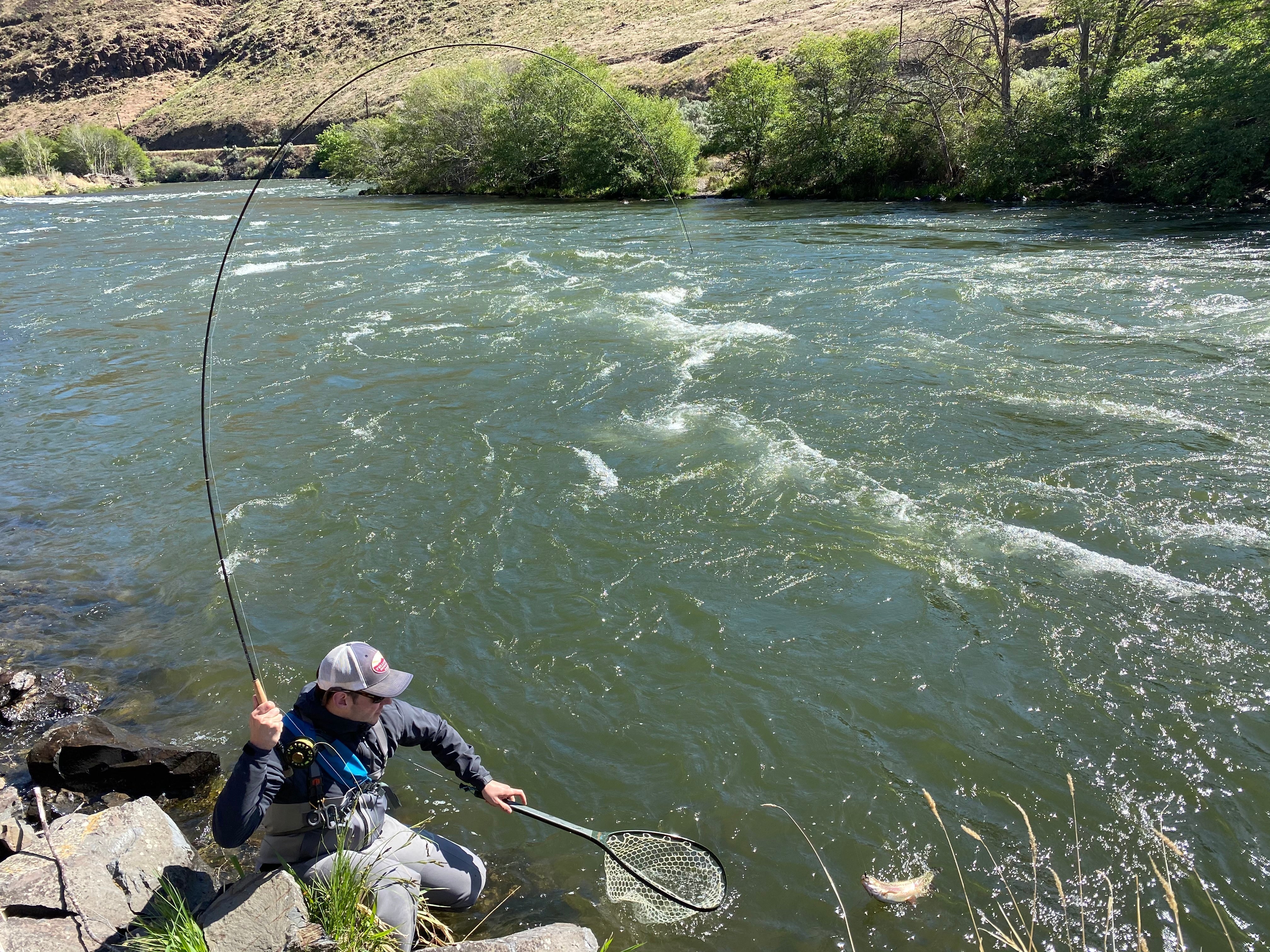
Last weekend was the big kickoff for the salmonfly/stonefly hatch here in Maupin and there were a lot of people here looking to fish the big bugs. The bug abundance was good, though early on enough in the hatch timing that not all trout had yet keyed in on eating them. There was another issue with last weekend and the early part of last week that made it less than absolutely ideal for big bug slaying: a FULL MOON. Here are all of the full moon days for 2026:

We had a FULL MOON on May 1 and that is a kiss of death for trout fishing. We are not allowed to fish for trout at night in Oregon, so the full moon is not a welcome companion on a fishing trip. The full moon is incredibly bright out here, with our super starry nights and cloudless skies. Why is that bad for the trout fishing? Well, under that ultra-bright lightbulb in the sky, desert trout tend to feed all night long and are less eager and active during the day. I never liked having trips on the days leading up to or coming out of a full moon, unless we happened to get lucky enough to have cloudy nights. The full moon did not mean that we caught ZERO fish, but it did have an impact on the abundance of happily feeding fish. I took this photo on Tuesday night, when the moon just wouldn’t let me sleep, mainly because I knew that I would be sharing some full moon info on this report.

Four full days after it was full, this moon kept the trout feeding all night long.
A truly well-rounded and dedicated angler will hit the river every week -or whenever time allows. If fishing is tough, that angler will have to dig deep and try all of his/her bags of tricks in order to eke out a few trout on the toughest of days.
The good news is that the full moon is behind us until the end of the month and it is now waning (getting smaller). It should no longer have an impact on our big bug fishing.
During the middle of this week, we hit another speed bump on the road to a perfect trout fishing day - the water levels coming out of the dam near Madras bumped up significantly overnight on Monday night, May 4, which always throws the trout into a tailspin and negatively affects their eating habits. It takes a few days for the trout to settle down and find their feeding lanes after a shift in the flows, and this week was no exception to that rule. Here is what a bump in the water looks like on the USGS web page monitoring the Madras water gauge (you can find links to the USGS pages under Quick Links on our website.

The good news is that the water flows are now stable and the fish are a lot happier than they were in the middle of this week.
Yesterday, the day before, and today had another element that some anglers find very frustrating to deal with: WIND. Gusty winds make casting difficult, but they also make it difficult for the big bugs to stay off the water. When the trees and the grasses are violently shaking, the salmonflies, golden stones, and little yellow sallies get sprinkled onto the water all day long and the trout line up under the trees in deeper water waiting to grab these juicy meals.
With some gusty winds in the Friday forecast, the river will get a good sprinkling of stoneflies today - which should bode well for Saturday and Sunday when the winds will be light and variable. Here is the forecast for the next ten days, showing wind on the bottom graph:

It looks like an absolutely LOVELY weekend on the horizon. This Sunday might be the best day to fish - according to the weather and also according to one other factor: it is Mother’s Day. For all you fly fishing mammas out there, I encourage you to get your breakfast in bed, then pack your gear and get yourself to the river! Hubby can watch the kiddos and you can truly celebrate your day with a deep bend in your fly rod. Sundays are rarely busy on the river because most anglers leave by noon - and Mother’s Day keeps many anglers on a short leash that doesn’t allow them to stray from home.
I gave a presentation to the Stonefly Maidens fly fishing club in Portland on Wednesday night. They are a lovely group of fly fishing ladies and I was honored to have a chance to speak to all of them about the Salmonfly/Stonefly Hatch on the Deschutes. The room was packed and I had a fun evening giving these ladies all the tips and tricks I have learned over 28 years of guiding the Deschutes and eating/sleeping/breathing this hatch. If you were there, thank you for coming! Now get yourself to the Maupin area to fish the hatch this weekend!
Here are the key things to know about fishing this hatch - you are not going to walk down to the river and see a bunch of fish boiling and rising all over the place. The stoneflies do not emerge by rising up out of the bottom of the river to the surface - the nymphs do a nightly crawl from the river to the vegetation on the edge of the river where they exit to the river to morph into their adult bodies. After that, they crawl around, sometimes making short flights from bush to tree to find a mate. They mate and then, only if the air temperatures are HOT, they take to the wing to get their eggs to the water. Salmonflies do not land on the water to lay eggs, they drop them from the air, but the golden stones do land on the water when ovipositing and they are, thus, much more available to the trout than the orange bugs.
Either imitation will work, however, because trout have to grab these bugs just as they splat onto the water. Trout are far more concerned with the shape of the fly than the color - this is why we have so many options in body color on the flies we sell in the bins at the shop. A purple chubby Chernobyl is a great example of a fly that has a completely weird body color and still hooks a ton of trout. Fly Fishing Author, Dave Hughes, got a tank of a trout on this trip a few years ago with one of the guides from our shop:

Purple Chubby for the win! Dave Hughes with a beautiful Deschutes Redside
Take a close look at the picture above. Do you see those tree branches hanging out over the water? These are providing the trout with a shady cool spot in which to chill and get out of the glare of the sun. The depth is good under that tree - allowing the trout to hang in the mid-water column while keeping an eye on the surface for snacks. The tree at this time of the year is also heavily laden with salmonflies and golden stones - many of them piled upon one another in what might be described as an orgy stack like this one:

It is easy to get knocked off the pile and into the water where the trout are eagerly waiting.
Two hours into writing this report now, and the sun is no longer shining in the window. The clouds have rolled in and blocked it out. The blanket of cloud cover is fantastic for fishing the Deschutes because the trout are far less wary when the sun is off the water. This is the reason that evening fishing is so darn good - the light leaves the water and the fish can come out from under the trees to feed all over the river with less fear of predation by ospreys. When I see cloudy light wind days in the forecast, I immediately get excited because I know two things: the fishing is better under the clouds, AND the cloud cover triggers the mayfly hatches to be their strongest and last the longest.
The March Brown mayflies have now been replaced by the Heptagenia mayfly aka the Pale Evening Dun. The PED is as large as the March Brown (size 12-14 imitations are best) and will hatch off in the mid-day. When the big mayflies are hatching out on the Deschutes, the trout will turn their attention from stoneflies to eat their favorite meal by far - mayflies. A little later in this month we will see the mack daddy of all Deschutes mayflies - the Green Drake - but we have not seen those yet. A fly shop 100 miles away from here reported that Green Drakes are hatching on the Deschutes, but we certainly have not seen that yet. There are lots of PEDs and they are largish - but they are certainly not Green Drakes. Believe me, no angler should ever mistake a Green Drake for anything other than what it is - a huge sausage with wings. Let’s just compare the smaller PED to the Green Drake in the next two photos:

THIS is a Pale Evening Dun (Heptagenia) mayfly - note the tapered body and 2 tails. PEDs are currently hatching in good numbers on the lower Deschutes near Maupin, ESPECIALLY on cloudy days.

This is what the fish see - the underside of a PED is straw-yellow colored. TASTY!

THIS is a Green Drake (Drunella grandis)- notice the thick and chunky body brown/dark green with 3 tails. The wing looks comically large and the body looks like a sausage. They are COMING SOON but have NOT YET HATCHED out on the Deschutes this year.
There are still quite a few Blue Winged Olive mayflies around to keep their larger mayfly buddies company. They are quite small and covering the wood siding on our house every evening. I took this photo on Wednesday night on my patio:

I realize the Blue Winged Olive in the photo is not perfectly in focus, but my hand is the hand in all of the above photos and the tiny insect on the end of my finger is a BWO - I merely post this for size reference.
In addition to the bonanza of salmonflies, golden stones, little yellow sallies, PEDs, and BWOS, the caddis are out in swarms every evening. John took our newest shop employee, Luke, out fishing two nights ago and he remarked that he had not seen swarms of caddis so thick in years. They were not fishing a caddis fly, because the trout that evening were gobbling golden stones out of the foam lines, but the caddis are here and can be another option for anglers looking for alternatives to the big bugs.
Alternatives to the big bugs? Why? Simply put, trout cannot make a steady diet of cheeseburgers. They will mix things up throughout the month of May and the smaller snacks like caddis and mayflies are simply the delicious side dishes that round out the meal. The best fishing guides on this river know that you have to have a diversity of insects in your fly box to have a successful day in May on the Deschutes. Here is a box of dries that I carry in May to cover the potential dry fly hatches of May:

This fly box has a smattering of options for fishing dry flies in May.
Dry fly fishing is the reason I fell in love with fly fishing. Seeing a trout come to the surface to eat your presentation is extremely satisfying. Maybe you tied the fly, or not, but you certainly selected it from dozens or hundreds of others as the fly to tie onto the end of your leader. You found the right type of water that holds trout, you made a cast that didn’t splat down too hard (stoneflies are okay to splat a little hard), didn’t put fly line over the fish, and floated drag-free just long enough to fool the fish. The trout had time to inspect your offering, it was scrutinized from head to tail, and the trout decided in the end, “YEP, that is exactly what I am looking for!” and it gets EATEN.
I love dry fly fishing so much more than nymphing that I will pause on the river with rising fish all around me to simply observe and learn as much as I can before even making the first cast. I will choose a fly, make sure that I am using small enough tippet to fool a picky trout, make one cast into the feeding lane, and let it drift through before picking it up. If it doesn’t get eaten on the first cast, and I am positive that it drifted through the feeding lane (a foam line) without drag and that the trout surely saw it but rejected it as a food option, I will immediately bring my fly back to me to change it out for another option from my fly box. Many times I have hooked a large trout in this manner after making 8-10 or even more fly changes, resting the water in between each singular rejected presentation of a fly. When I finally make the right choice and the picky trout accepts my offering, I feel so good that I don’t even care whether or not I get the fish to the net. I won the challenge and will move on to the next feeding lane with a new database of information on what it is that the trout are eating today, at this very moment. It is a great feeling to solve the entomological mystery - like the feeling you get when placing the very last piece into the 1000 piece puzzle - total satisfaction.
Nymphs are always an option to fish on the Deschutes and usually the easiest route to catch trout. But, in my opinion, nymph fishing all day long during the month of May or June is nearly criminal. It is akin to skiing groomed trails all day long when you have travelled to Utah for a skiing adventure. Sure, the groomed trails are easier and uniform and predictable to ski. The groomed trails, like the nymphs, are always an option and one that will assure that you get a lot of vertical feet skied in that day. You will hook trout on nymphs. But, you can do that any month of the year. You can ski groomed trails on any ski hill in New Jersey - why make a trip to the mecca of powder skiing just to stay on the groomed trails? You are missing out on a great opportunity to grow as an angler if you don’t try dry fly fishing when you visit the Deschutes in May and June.
Most skiiers know that skiing in deep, feather-light powder sends a thrill of electricity through your body. Most anglers know that fishing a dry fly can give you the same thrill if you can trick the trout into eating your dry fly. You have to make a great cast, the drift must be perfect, and you must be patient as you watch the large dark shape appearing under your fly. Microseconds feel like minutes until a huge jaw breaks through the foam to engulf your offering. A quick lift of the rod, and you feel the weight of the beast as your rod doubles over. THAT is an electric feeling and one that cannot be matched by watching an indicator.
Dry-dropper fishing is not nymphing, and I am a big fan of using this technique leading up to the dry fly action coming on strong. Euro nymphs are a great choice to use for a dropper because they get into the feeding lane immediately and stay there thanks to the tungsten bead. Often a dropper can get a trout’s attention and get them to rise up for the shiny bead. As they are tilted up to grab your nymph, they may see the stonefly dry you are using to suspend the bead and they just may grab that too. Once the dry is getting regular eats, you know that it is time to cut off the dropper and go to town with that dry!

Fishing a dry dropper rig pays off in the heavy water prior to dry fly fishing in the afternoon. Kelly LOVES her dry fly fishing but knows that we sometime have to use a dropper when dries alone are not working.
A good way to learn about the intricacies of fishing dry flies on the Deschutes is to hire a guide who really REALLY really knows the river and specializes in dry fly fishing. There are so few, even during the middle of the salmonfly hatch, that take the time to hunt for dry fly eaters. It is the hardest way to guide. I know, because that is all I ever wanted to do when guiding, but not every client is up to the challenge. A guide might have to spend several hours in the morning helping that person learn how to cast well enough to be a good dry fly angler, only then can the guide share with them the thrill of getting big redsides on dries. It is far easier for most guides to tie on an indicator and a couple of heavy nymphs, pull into every riffle, and sit in the boat while you fling your bobber-rig upstream over and over again. Guiding dry fly anglers requires the guide to be focused and at your side every minute of the day, helping you understand the tiny nuances in dry fly presentation that lead to hooking trout on dries. It is a lot of work and some guides don’t want to work that hard. I no longer guide the Deschutes due to having to run the fly shop, but there are still a handful of good guides out there who love the hunt for trout on dries.
Planning a guided trip for the salmonfly hatch needs to take place months, if not one full year, in advance. Guides who are still looking to book dates on their calendar this close to the most famous hatch of the year are not likely to be guides with a ton of experience guiding the river. There are a lot of new faces out there rowing boats and taking your money as they learn the river. I laugh whenever I read this on a website: “Our guide service has 50 (or even 100) years of combined experience guiding fly anglers” Really? What does the number of COMBINED years of experience have to do with anything? Are we going out on a fishing trip with all 25 of your guides simultaneously guiding us? I think that could be the only way that all of those combined years of experience could possibly matter.
It is so easy for someone to write up something in a Bio like: “Three years experience in the fly fishing industry” when he/she worked in a fly shop for 4-5 months one year, mainly washing windows, stocking shelves, and dusting the displays before getting let go for lack of work ethic. The next year that person might have gone to Alaska (many guides get their start in Alaska because the guide turnover rate is huge) and worked washing dishes, chopping wood, and cleaning fish for the majority of the time with a few walk-wade trips thrown in when the lodge got really busy and a full-time guide got sick. Now that “guide” is in a third job with a third fly fishing operation, has about 6 days of actual guiding under his/her belt, and is thrown on a brand-new river to take your $$$ to learn the new water.
Yes, we all have to start somewhere, but the start to a guiding career should be countless hours and days spent on the river that he/she will be guiding. Spending time learning the water, ideally under the mentorship of an experienced guide (who also had a mentor or mentors decades before), is the best way for someone to become a guide.
Ask a lot of questions of a guide before you hire them - how long have you been fly fishing, when did you start guiding, and if I really want to concentrate on dry fly fishing - ask them if it is something that they do often on their guided trips. Let that guide know what you are hoping for on a guided trip - and be honest about your skill level. Practice your dry fly casting for months and weeks leading up to the trip. Be prepared to pivot to a dry-dropper or a nymph rig if conditions are difficult. Hiring a guide is about so much more than racking up numbers of fish under a bobber - it CAN be a chance to learn new skills, to understand more about reading dry fly water, and to have the thrill of hooking a monster that you WATCHED come up to eat your dry fly.

A hard working guide never sits in the boat napping while you fish. They are at your side, coaching, spotting fish, selecting the right flies, and helping you know the best places to cast.
The first days to get filled on any Deschutes guide’s calendar are May 10-June 1. This window covers the salmonfly hatch from Maupin up to the Warm Springs boat launch - on most years. The water temperatures, water levels, and weather patterns will shift the timing of the bugs slightly. Our hatch started off a week earlier this year due to warmer lower water and hotter days. If you can dodge the full moon by three days on either side, you will have better fishing, but a good guide can make magic happen even under the most challenging conditions.
If you are still looking for a guide for a day in the next few weeks, keep calling around and put your name on the radar of your chosen guide/s to let them know that you can fill a seat in half a boat or get to the river in mere hours notice should that guide have a last minute cancellation.
This should be a EPIC weekend for fishing the Deschutes. Stop in and we will help you get the right stuff for success.


Amy—
I always come away from your reports more connected to all the factors that go into catching a fish—moon cycles, water levels, and attitude. Appreciate you!
Brent
Thanks for another great report. Yep, yesterday’s wind was a challenge. Caught an even dozen, a few nice sized, but all deep with a tungsten stone nymph on the point and a little sally nymph on the tag. Am looking forward to Monday to try plopping big bugs under trees in deeper shady spots. 👍
Great post re the moon’s effect as well as essential reminders to pay attention to water levels, cloud cover and how these effect trout behavior and insects. Thanks for all the knowledge you share!